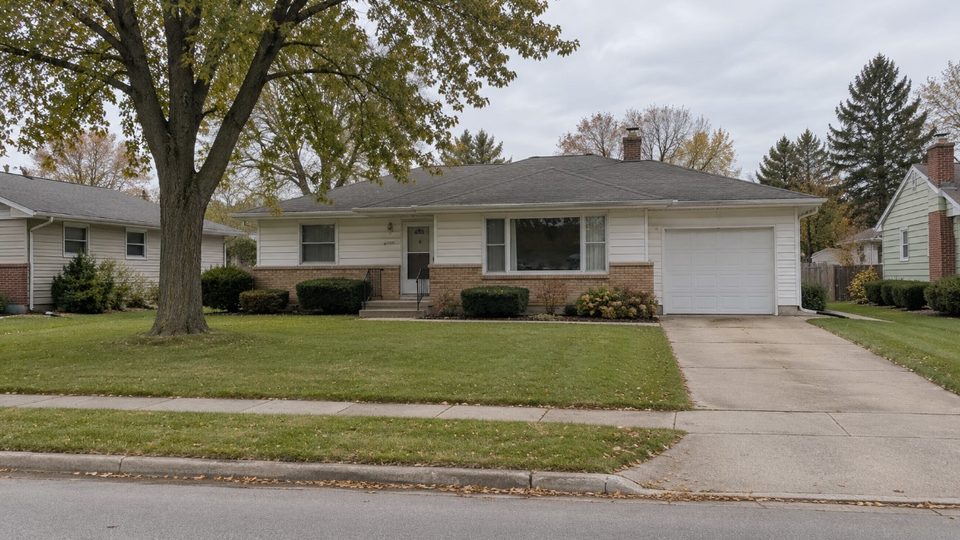
A Postwar Subdivision, Finished in the Eighties
Fischer Heights is postwar subdivision housing, and its moisture profile is about as consistent as any area we cover. The ground is good, the foundations are concrete block, and there is no regional water problem. Nearly everything here is a building-level issue, and nearly all of it comes back to one thing: basements finished twenty or thirty years after the house was built.
The assembly is the same one that fails across this climate zone — studs tight against the block, fiberglass batts, paper-faced drywall, carpet on the slab — and the reason it is so consistent here is that a whole neighborhood of similar houses got finished in a similar period by similar contractors. If your neighbor has found something behind their basement wall, that is genuinely relevant information about yours.
Why the first sign is usually smell
Growth on the concealed face of the drywall and along the bottom plate is completely invisible. No stain reaches the room side for a long time, because the paper facing on the room side stays dry. What does reach the room is the smell, and it is usually noticed first in a closed-up part of the basement, or after returning from a week away. A musty smell in a finished basement with nothing visible is not nothing — it is the normal presentation.
Serving Fischer Heights, WI
Call and tell us what is happening in your Fischer Heights property. A specialist will talk it through with you — free, and with no obligation.
(608) 724-1919Free phone consultation.
Attic Sheathing Above Bathrooms and Laundries
The second recurring call. Exhaust ducts run into the attic rather than through the roof, or run correctly at the time and since come apart at a joint. The signature is a dark cone of staining on the sheathing directly above the room in question, and in midwinter you can sometimes see frost on the nail points in the same area.
The laundry version is worth flagging separately, because a dryer puts several liters of water into the air per load. A dryer vent that is disconnected, crushed, or discharging into the basement or a crawl space is a very large moisture source running several times a week.
Sump Pumps at the End of Their Life
The subdivisions here were built with sump systems and a good proportion are still on the original or second pump, with no battery backup. The two failure modes arrive together: a spring storm overwhelms a tired pump, and the same storm takes the power out. A backup pump or a battery unit is inexpensive against a $4,000 to $12,000 finished basement remediation, and it addresses the single most likely cause of one here.
The Quiet Ones: Water Heaters and Laundry Connections
A slow weep at a water heater base, or a washing machine hose fitting, on a finished lower level. It runs behind the appliance where nobody looks, soaks into the bottom of the adjacent wall and the carpet pad, and produces no dramatic event at all. Worth a flashlight behind both appliances twice a year. Replacing rubber washer hoses with braided stainless is a twenty-dollar job that removes one of the more common causes of a large claim.
What Works Here
- Find out what is behind the finished wall before you have a reason to
- Battery backup on the sump, and a second pump if the pit fills fast
- Trace every exhaust duct, including the dryer, to where it actually terminates
- Braided stainless washer hoses instead of rubber
- A dehumidifier plumbed to the sump, April to October
- Rim joist air sealed and insulated while the basement is accessible
- If it is rebuilt: rigid foam against the block, paperless board, no carpet on the slab
What We Get Called About Most in Fischer Heights
Ranked by how often it comes up, and tied to the buildings that are actually here rather than to mold in general.
- Postwar subdivision basements finished in the 1980s and 1990sThe dominant call. Block walls, a stud wall built against them, batt insulation and paper-faced board. Growth runs on the concealed face for years before anything reaches the room, and the first sign is usually smell rather than sight.
- Attic sheathing above bathrooms and laundriesExhaust ducts that were run into the attic rather than through the roof, or that were run correctly and have since come apart at a joint.
- Sump pumps at the end of their lifeOriginal or second-generation pumps with no battery backup, in a neighborhood where a spring storm and a power cut arrive together often enough to matter.
- Water heaters and laundry connectionsA slow weep at a tank base or a washer hose on a finished lower level, running behind the appliance for months.
Neighborhoods and Sections We Cover in Fischer Heights
Mold Services Available in Fischer Heights
Mold Inspection
Thermal imaging and moisture metering to find the source before anything is opened up.
Basement Mold Removal
The dominant mold problem in Fischer Heights — finished basement walls, limestone and block foundations, and sump failures.
Black Mold Removal
Full containment for water-damage indicator species, plus finding the sustained water source that let it establish.
Attic Mold Removal
Sheathing and rafter growth traced back to ventilation, bath fans or ice damming.
Water Damage & Flood Mold
Frozen and burst lines, sump failures and Rock River flooding — the 24 to 48 hour response window.
Clearance Testing
Independent verification by someone who did not perform the remediation.
What Mold Work Costs in Fischer Heights
General market ranges for south-central Wisconsin, listed for the situations that actually come up in Fischer Heights. These are planning figures rather than quotes — nobody can price a job they have not seen, and what moves a number most is the size of the wet area rather than the stained area. The full cost guide explains what drives each one up or down.
| Work | Typical range | Notes |
|---|---|---|
| Mold inspection with thermal imaging and moisture metering | $250–$600 | Most projects should start here |
| Finished basement — wall removal, drying, clearance | $4,000–$12,000 | Excluding reconstruction |
| Attic remediation with cleaning, treatment and re-insulation | $2,800–$7,500 | Ventilation correction usually extra |
| HVAC coil, plenum and duct cleaning | $600–$1,800 | Where the air handler is distributing the problem |
| Independent post-remediation clearance testing | $400–$900 | Should not be the same firm that did the work |
Prices shown are examples only. For an accurate quote for your specific situation, call (608) 724-1919 — free consultation with a specialist.
Mold FAQ — Fischer Heights, WI
It is the standard presentation in this housing, and it is worth taking seriously rather than dismissing. Growth on the back of the drywall and along the bottom plate produces no visible sign on the room side for a long time, because the surface you can see stays dry. The smell is the only thing that gets out. Non-destructive checks: a moisture meter along the lower two feet of the board, a look into the cavity through an outlet box with the cover plate off, and a corner of carpet lifted at the wall.
As a rule of thumb, most residential pumps run seven to ten years, and a pump that is original to a 1980s house has long since earned replacement. But age is less useful than testing: pour a bucket of water into the pit and watch it cycle. If it is slow to start, runs rough, or does not shut off cleanly, replace it. And whatever its age, a pump with no backup is a single point of failure in a house where the failure costs five figures.
It is genuinely relevant, which is unusual — mold is normally a per-building question. In a subdivision like this, similar houses were finished in a similar period using the same assembly, and they share ground conditions and drainage patterns. If the house next door has it, the odds that yours has the same assembly are high. That does not mean you have growth; it means the non-destructive checks above are worth doing rather than waiting.
If it is caught as a humidity problem before growth establishes: a dehumidifier and some air sealing, a few hundred dollars. If the finished wall has to come out: $4,000 to $12,000 for remediation excluding reconstruction. Attic work after a bath fan has been discharging into the roof space: $2,800 to $7,500 with the ventilation correction on top. The whole range is decided by how early it is found.