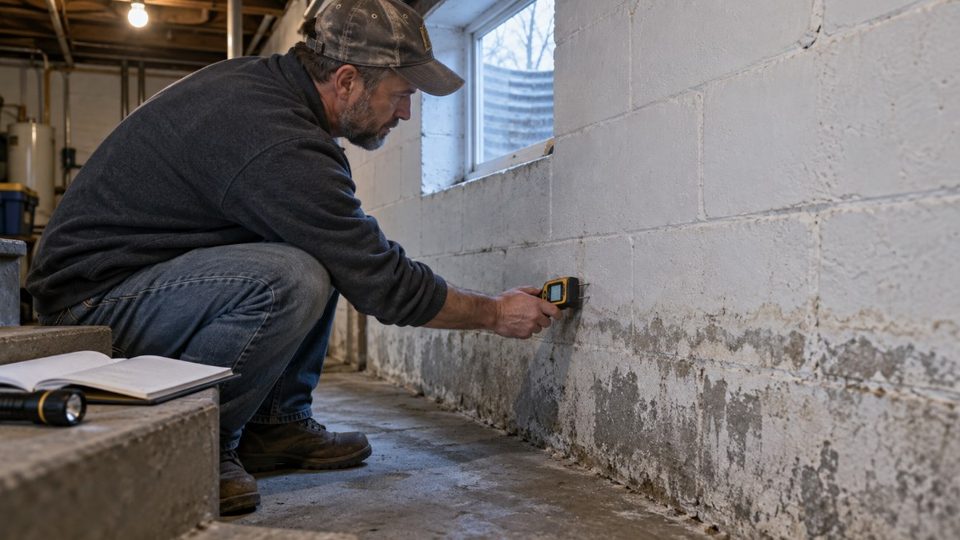
What an Inspection Is Actually For
An inspection is not a hunt for mold. You can generally find mold yourself; what you cannot do is work out how far the wet area extends behind the finish, how long it has been wet, and where the water is coming from. Those three answers decide everything that follows — whether material is dried or removed, what the job costs, and whether it comes back.
A good inspection in Janesville starts from the age of the building. A pre-1900 house with a limestone cellar, a 1920s foursquare with a basement finished in 1985, and a 2010 subdivision house fail in three different directions, and an inspector who does not ask when the house was built is not using the most informative fact available.
Tell us what you have seen
Describe the stain, the smell or the meter reading that worried you, and where in the building it is. You will get a straight answer on whether an inspection is worth booking or whether the cause is already obvious.
(608) 724-1919Free phone consultation.
What a Proper Inspection Covers
- The full basement perimeter at floor level, where water arrives first
- The rim joist — the band of framing on top of the foundation, and the coldest wood in a Wisconsin building
- Behind finished basement walls, using a moisture meter rather than only the eyes
- Under and behind every plumbing fixture, including the toe kicks
- The crawl space, if there is one, including under additions
- The attic: sheathing, rafters, the ceiling plane, and where every exhaust duct terminates
- The air handler, coil and condensate pan
- Windows, sills and the reveals of exterior walls
- Exterior grading, gutters and downspout discharge, which is where a great deal of basement water begins
The Tools, and What Each One Answers
| Tool | What it tells you | Limit |
|---|---|---|
| Thermal camera | Temperature differences across a surface, which frequently reveal wet areas and missing insulation without opening anything | It sees temperature, not moisture. Every finding has to be confirmed with a meter. |
| Pinless moisture meter | Relative moisture content through a surface, non-destructively, so large areas can be swept quickly | Reads a depth range, and is fooled by foil facings and metal behind the wall. |
| Pin meter | Actual moisture content at a known depth in wood or drywall | Leaves two small holes. This is the reading that should appear in the report. |
| Hygrometer | Air temperature and relative humidity, from which dew point is calculated | Needs to be read in several places, including outside, to mean anything. |
| Borescope | Sight into a wall cavity through a small hole, rather than opening the wall | Shows one small area. Useful for confirming, not for surveying. |
What You Should Get in Writing
A verbal summary at the door is not an inspection report. What should arrive afterwards:
- Actual readings, with locationsMoisture content figures at identified points, not "elevated moisture in the basement".
- A stated moisture sourceOr, honestly, a shortlist with what would confirm each. "Unknown" is acceptable; silence is not.
- The extentHow far the wet area runs, and how that was determined.
- PhotographsIncluding thermal images where they informed a conclusion.
- A recommended scopeWhat should be removed, what can be dried, and what has to be corrected outside the building.
- What you can do yourselfA good report says so where it applies.
How the Readings Are Interpreted
A moisture meter produces a number, and the number on its own means nothing. What makes it evidence is the comparison.
Reference readings
The inspector takes a reading from an unaffected area of the same material in the same building — a stud in a dry wall, a patch of subfloor away from the water — and that becomes the baseline. Everything else is read against it. A framing member reading 12 percent where the reference reads 11 is normal; the same 12 percent where the reference reads 8 is a finding. Without the reference, an absolute figure is unanchored.
Pin versus pinless, and why both get used
A pinless meter reads a volume beneath the surface and is used to sweep quickly and find anomalies. It is affected by density and by anything metallic behind the wall, so it produces false positives. A pin meter measures resistance between two probes at a known depth and gives a figure that can be quoted. The sequence is sweep with pinless, confirm with pins. A report containing only pinless readings is a survey, not a measurement.
Dew point, and the calculation that settles seasonal cases
For any suspected condensation problem the inspector should record indoor temperature and relative humidity, outdoor temperature and relative humidity, and the temperature of the suspect surface. From the first pair the dew point is calculated. If the surface is below that dew point, condensation is not a theory — it is arithmetic. This one calculation resolves the majority of Janesville basement calls without anything being opened.
What Gets Missed, and What to Ask the Inspector to Check
These are the locations that turn up repeatedly in Rock County and that a general inspection is not scoped to reach. Naming them on the phone costs nothing and changes what gets looked at.
- The rim joist, at the coldest corner, with the insulation pulled back
- Behind finished basement walls, with a meter rather than by eye
- The sill plate where it meets the foundation
- Under the bottom stair tread and behind the stringer
- Inside the sink cabinets, including behind the toe kick
- Where every exhaust duct actually terminates — bath, laundry, dryer, range
- The evaporator coil and condensate pan inside the air handler cabinet
- The crawl space under any addition, not just the main one
- Window sills and the reveals of exterior walls
- Downspout discharge points, during or just after rain if possible
How Long It Takes and What It Does Not Cover
A thorough residential inspection runs one and a half to three hours depending on size, access and how much of the basement is finished. Longer on a pre-1940 house, because there is more to look at and the readings are less uniform.
What an inspection is not: a structural survey, a code inspection, a pest inspection, or a guarantee that nothing exists inside a wall that was not opened. Nobody can certify a closed cavity as clear without looking into it, and an inspector who offers that is overselling. What it does do is tell you where the water is, how far it has gone, and what the scope of work should be — which is what every subsequent decision depends on.
When an Inspection Is Not Worth Buying
There are situations where the money is better kept. If the damp appears every July on a cold basement wall and dries out in fall, that is condensation, and the answer is a dehumidifier and some air sealing rather than an inspection. If you can see a small patch of mildew on bathroom grout, that is a ventilation and cleaning question. If a supply line burst yesterday and you already know exactly what got wet, the priority is drying it, not surveying it.
Frequently Asked Questions
Roughly $250 to $600 for a dedicated mold inspection with thermal imaging and moisture metering in this market, with larger or older properties at the upper end. Adding an air sampling package with an outdoor control is typically another $250 to $550. Those figures sit below Madison and well below Chicago, which is worth knowing when you read national cost guides. The cost guide has the full table.
Often a great deal, and that is what the phone call is for. The seasonal pattern, the location and the age of the building narrow the likely cause considerably before anyone visits. If your basement is damp every July and dry every January, that is condensation rather than intrusion, and it points at a dehumidifier rather than an inspection. Call (608) 724-1919 and describe what you are seeing — including when the answer turns out to be that you do not need one.
It will find the moisture inside the walls, which is the useful part, and it does that without opening anything. Confirming growth visually means either a borescope through a small hole or opening a section. A competent inspector will tell you when the readings make opening worthwhile and when they do not. Nobody can certify a wall cavity as mold-free without looking in it, and an inspector who claims otherwise is overselling.
Yes, and it is the single best-value inspection anyone in this county buys. Finishing a basement over an unresolved moisture problem builds the problem into the wall where it will run unseen for years. While the space is open, test for radon too — Rock County is an EPA Zone 1 county and the same slab joints carry both. Doing both before the studs go up costs a fraction of discovering either afterwards.
It helps considerably. You know the history — when it started, what the weather was doing, which corner smells, what happened in 2008. That history frequently shortens the diagnosis by an hour. If you cannot be there, write the timeline down and leave it.