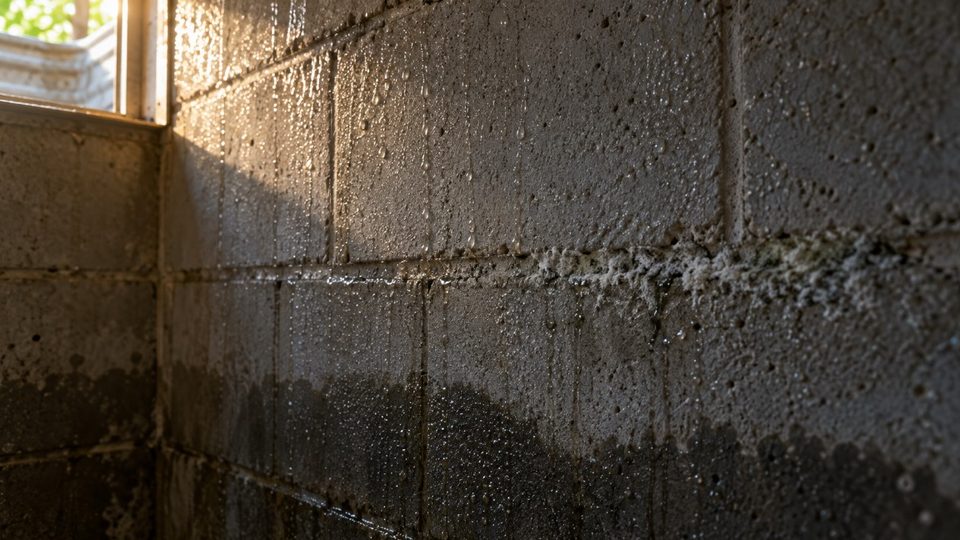
The Pattern That Gives It Away
Damp in July, dry in January. If that describes your basement, you almost certainly do not have a leak, and almost everything sold to fix leaks will do nothing for you.
A leak does not behave seasonally in that direction. Groundwater intrusion peaks in spring, when the snow melts and the ground is still frozen. Plumbing leaks are constant. A problem that appears reliably in the warmest, most humid months and clears in fall is condensation, and condensation is a completely different repair.
Have a specific situation?
This article covers the general case. For your own building, call and describe what you are seeing. The conversation is free.
(608) 724-1919Free phone consultation.
Why a Cold Wall in a Warm Month Gets Wet
A buried foundation wall in Janesville sits at roughly deep-earth temperature all year, in the low to mid 50s Fahrenheit. It barely moves with the seasons, because it is insulated by several feet of soil.
From June through September, dew points in southern Wisconsin regularly run into the 60s for weeks at a time. Dew point is simply the temperature at which air has to give up its water. Air with a dew point of 65°F that touches a surface at 55°F is already past the point where it can hold what it is carrying, so it deposits the difference as liquid water on that surface.
Nothing leaked. The water was in the air, and your wall is a condenser.
This is the single most common piece of well-meant bad advice in this county. Opening a basement window in July brings in air at, say, 85°F and a 68°F dew point, and delivers it to masonry at 55°F. You have not ventilated the basement; you have supplied it with fresh moisture at a rate the previous air could not match. The correct move in summer is the opposite: keep the basement closed and dehumidify it.
Where It Shows Up First
- The bottom two or three feet of the foundation wall — the coldest part, because it is deepest.
- Cold water supply lines — visibly beaded, dripping onto whatever is beneath them. People frequently report this as a plumbing leak.
- The underside of the first floor and the rim joist — particularly where a duct or a cold line runs.
- The slab — a concrete floor can sweat, and anything porous sitting on it will wick.
- Behind boxes and against walls — wherever air does not move, the local humidity is higher.
How to Confirm It Yourself in a Weekend
- Buy a hygrometerTwenty dollars. Put it in the middle of the basement and leave it for a week.
- Read the relative humidityAbove 60 percent through the summer is the confirming finding on its own.
- Feel the wall and the floorCool and damp to the touch, with no source above and no path from outside, is condensation.
- Tape a square of plastic to the wallA foot of clear polyethylene, taped on all four sides, left for two days. Moisture on the room side means condensation from the air. Moisture on the wall side means water is coming through the masonry. This single test separates the two mechanisms.
- Check the timing against the weatherDoes it track humid spells rather than rainfall? Condensation follows dew point; intrusion follows rain.
The Fix, and What It Costs
None of this requires a remediation crew unless growth has already established.
- A correctly sized dehumidifier, plumbed to the sump or a floor drain so nobody has to empty a bucket, set to 45–50 percent, running April to October. This is the main intervention.
- Close the basement to outdoor air in summer. Windows shut. If there is a vented crawl connected to it, that needs dealing with too.
- Insulate cold water lines with foam sleeve. A few dollars, and it stops the drip that gets reported as a leak.
- Air seal and insulate the rim joist, which is doing the same thing in winter for the opposite reason.
- Move stored material off the slab and off the walls, so air can circulate.
- If the basement is finished, understand that the same condensation is happening on the back of the drywall where you cannot see it.
Total cost for an unfinished basement: typically a few hundred dollars. Compare that with an interior waterproofing system, which is frequently quoted for exactly this symptom and which addresses a mechanism that is not occurring.
When It Is Not Condensation
Be honest with the diagnosis, because two mechanisms can run at once and fixing one leaves you convinced the work failed. Look again at intrusion if the damp is worst after rain rather than during humid spells, if it is concentrated at one point rather than general, if there is a tide line or efflorescence high on the wall, or if it is also wet in March and April. A basement with both summer condensation and a downspout discharging at the wall needs both dealt with.
Questions This Article Raises Most Often
For most Janesville basements, a 50-pint unit handles up to roughly 1,500 square feet, with a 70-pint unit for larger or wetter spaces. More important than the capacity is that it is plumbed to a drain rather than filling a bucket — a unit that switches off when the tank is full is not controlling anything. Set it to 45 to 50 percent and leave it running from April through October rather than switching it on when the basement feels damp.
Modestly, and it usually pays for itself in other ways. A dehumidifier is essentially a small air conditioner and it does use electricity continuously through the season. Against that, it prevents a remediation that runs into four or five figures, and dehumidified air feels cooler at the same temperature, so upstairs cooling costs often fall slightly. Running it only when you remember is the expensive option, because the humidity is doing damage in the periods you forget.
Then their problem was probably intrusion rather than condensation, and drain tile was the right answer for it. The two symptoms look similar and the mechanisms are opposite. The plastic-square test in the article separates them in two days and costs nothing. Do it before spending five figures on a system for a mechanism you may not have — and note that a contractor selling drainage will not usually offer to run that test for you.
Not for condensation, because the water is coming out of the air and landing on the surface rather than coming through the wall. Waterproof paint changes nothing about that, and on an older limestone or brick wall it does active harm by stopping the masonry drying inward. If you want the walls to look better, a vapor-open masonry paint is acceptable; anything sold as a waterproof barrier is the wrong product for this problem and the wrong product for these walls.
Smell is a genuine finding, not imagination, and in a condensing basement it usually comes from one of three places: stored cardboard and paper that has been wicking moisture off the slab, the underside of the first floor and the rim joist, or the back of a finished wall if there is one. Move the storage first — it is free and it is the commonest answer. If the smell persists after two weeks of dehumidification, something is holding moisture that needs finding.