Why a Mold Site Is Talking About Radon
Two reasons, and neither is a sales pitch — nobody on this site sells radon testing or mitigation.
The first is that in Rock County the numbers are genuinely unusual. This is an EPA Radon Zone 1 county, meaning the predicted average indoor screening level is above the EPA action level of 4 pCi/L. Around half of the homes tested in Rock County come back at or above that level, and three Janesville ZIP codes rank among the highest in the state, with exceedance rates reported between 59 and 100 percent of homes tested.
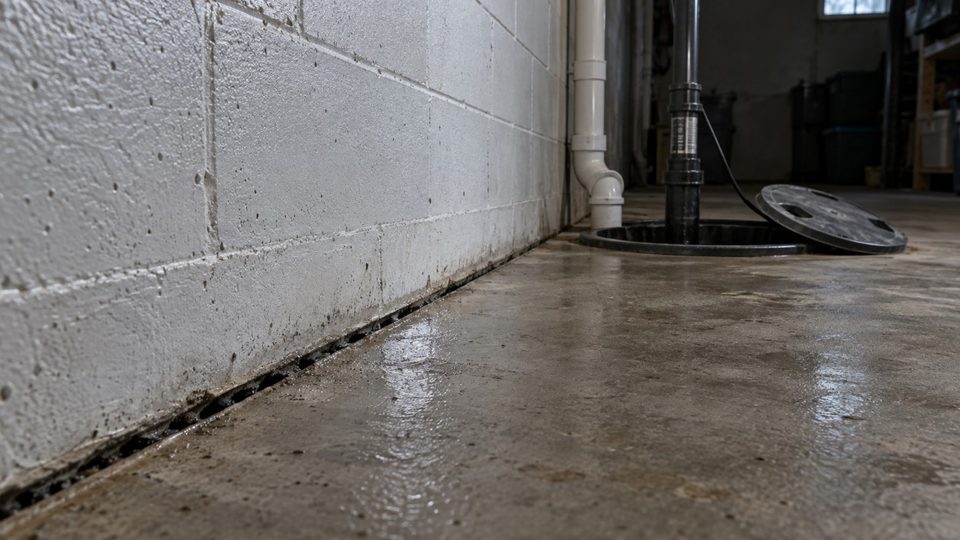
The second is that radon and moisture use the same doors. The slab-to-wall joint, shrinkage cracks, the sump pit, utility penetrations, and the gap around a floor drain — those are the entry routes for soil gas and for water vapor alike. If a basement is being opened up for any reason, that is the cheapest moment in the building's life to deal with both.
Have a specific situation?
This article covers the general case. For your own building, call and describe what you are seeing. The conversation is free.
(608) 724-1919Free phone consultation.
What Radon Actually Is
A colorless, odorless radioactive gas produced by the natural decay of uranium in soil and rock. It seeps out of the ground everywhere, harmlessly, into open air. It becomes a problem when it enters an enclosed space and accumulates — which is what a basement is.
The health consequence is well established and is not in the same category as the contested claims that circulate about mold. Radon is the second leading cause of lung cancer after smoking, and the risk is multiplicative for smokers. Unlike indoor mold, it has a defined action level and a straightforward, inexpensive test.
We write a great deal on this site about mold, and we are careful to say that the evidence supports a real but moderate picture: damp buildings are associated with respiratory symptoms and asthma exacerbation. Radon, in this county, is a larger and better-quantified risk, and the test costs less than any other item discussed anywhere on this site. If you do one thing after reading anything here, make it the radon test.
The Shared Entry Routes
| Route | Carries radon | Carries water vapor |
|---|---|---|
| Slab-to-wall joint (the perimeter gap) | Yes — the largest single route | Yes |
| Shrinkage cracks in the slab | Yes | Yes |
| The sump pit | Yes, especially if uncovered | Yes |
| Floor drain | Yes if the trap dries out | Yes |
| Utility and plumbing penetrations | Yes | Yes |
| Hollow block wall cores | Yes | Yes |
| An earth or broken cellar floor | Yes, heavily | Yes, heavily |
Note the overlap is essentially complete. Sealing the slab joint and covering the sump pit reduces both. A sub-slab depressurization system — the standard radon mitigation — also draws soil moisture away from under the slab, which is a genuine secondary benefit for a damp basement.
Stack Effect Makes Winter Worse for Both
In a cold climate, warm air rises and leaves the building at the top, which draws replacement air in at the bottom. In practical terms a Wisconsin house in January is gently sucking air out of the soil beneath it, through every one of the routes above. This is why radon levels are typically highest in winter, and it is the same mechanism that carries basement humidity and basement smells upstairs into the living space.
It is also why a basement problem is never only a basement problem in this climate. Whatever is in that air ends up upstairs.
What to Do
- TestA short-term test kit costs very little; free kits are periodically available through Rock County Public Health. Test in the lowest lived-in level, over at least 48 hours, with the house closed up normally.
- If the result is at or above 4 pCi/L, retest or go straight to mitigationA long-term test gives a better annual average, but a clearly high short-term result is enough to act on.
- Mitigate if warrantedSub-slab depressurization is the standard: a pipe through the slab, a fan, and a vent above the roofline. Typically $900 to $2,200 installed in this market.
- Do it while the basement is openIf remediation, drainage work or finishing is happening anyway, the sealing and the pipe routing are far cheaper now than later.
- Retest afterwardsSame as clearance testing for mold: verify rather than assume.
Before You Finish a Basement
This is the practical headline. Finishing a basement in Rock County without testing for radon first means that if the result is high, the mitigation has to be retrofitted through finished walls and floors. Testing costs a fraction of one square meter of that finished basement, and the answer changes the design — sealing details, sump pit cover, and whether a passive pipe should be built in while the slab is accessible.
Questions This Article Raises Most Often
Short-term test kits are sold at hardware stores and online for a low cost, and Rock County Public Health has periodically made free kits available to residents — worth checking with them first. The Wisconsin Department of Health Services maintains guidance and information on testing and on finding a mitigation contractor. Follow the kit instructions on closed-house conditions, because a test taken with windows open will read artificially low and tell you nothing.
The entry is the same; the exposure differs. Radon enters through the slab and walls regardless of what is built in front of them. What changes with finishing is how much time people spend down there, which is what drives the health risk, and how hard mitigation becomes afterwards. A high radon result in an unfinished basement used for storage is worth fixing; the same result in a finished family room where a teenager sleeps is more urgent.
No, and it is worth not confusing the two. A dehumidifier removes water vapor from the air in the space; it does nothing about a radioactive gas entering through the slab. The reverse is partly true — a properly installed sub-slab depressurization system draws soil gas and some soil moisture away from beneath the slab, so it can modestly help a damp basement. But radon mitigation is not a moisture solution and a dehumidifier is not a radon solution.
Sealing helps and is part of a proper job, but on its own it is rarely sufficient. There are always more routes than the ones you can see, and hollow block walls in particular are effectively a network of channels. The standard and effective approach is sub-slab depressurization, which uses a fan to hold the space under the slab at lower pressure than the basement so soil gas goes up the pipe rather than into the house. Sealing then improves how well that system performs.
Yes — in this county it is one of the highest-value items in an inspection window. It costs very little, the result is actionable, and if mitigation is needed it is a legitimate negotiating point. It is also worth asking directly whether the property has ever been tested and whether a system has been installed; an existing mitigation system is a positive, not a red flag, provided it is working and has been retested.