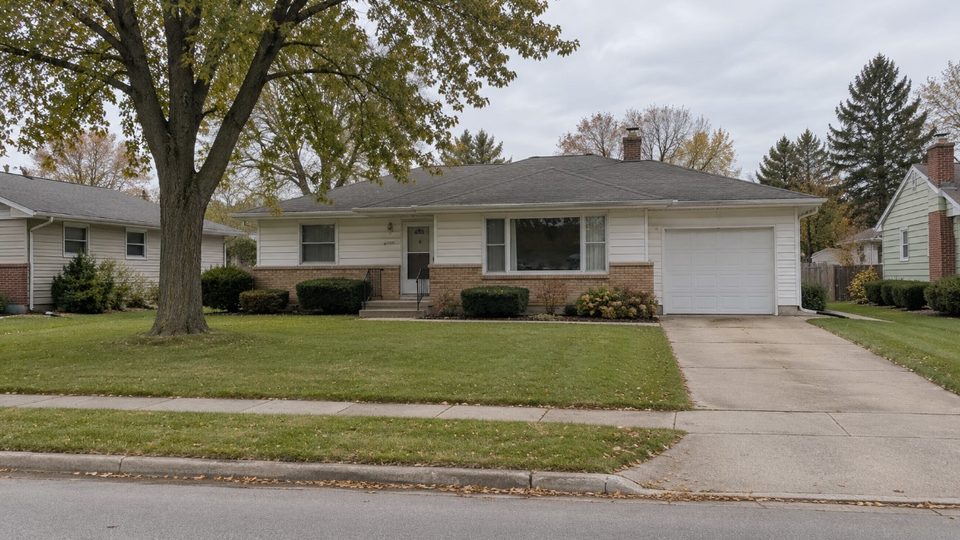
Postwar Housing, Basements Finished a Generation Later
Merrick Park is largely postwar, and its moisture profile is completely different from the older districts across the river. The ground is higher, the foundations are concrete block rather than limestone, and the water problems are local to the building rather than regional. That is good news: almost everything here is fixable at the property.
The dominant call from this area is the finished basement. These houses were built with unfinished basements and a great many were finished in the 1970s, 80s and 90s, using the assembly that fails across this whole climate zone.
Studs tight against the block: the back of the framing sits at wall temperature, which for months is below the dew point of the room air. Fiberglass batts: stop neither air nor vapor, and hold whatever condenses against the board. Paper-faced drywall: the facing is cellulose, which is food. Carpet and pad on the slab: a sponge on a surface that transmits ground moisture. And the whole thing is sealed shut, so it runs for years before anyone smells it.
Serving Merrick Park, WI
Call and tell us what is happening in your Merrick Park property. A specialist will talk it through with you — free, and with no obligation.
(608) 724-1919Free phone consultation.
Bath Fans That End in the Attic
The second most common call, and the cheapest to fix. Unmodernised postwar bathrooms here either have no exhaust fan at all, or have one that terminates above the ceiling rather than through the roof. The result is a distinct dark cone of staining on the sheathing directly above the bathroom, and in a Wisconsin winter it can be dramatic — frost on the nails and visible moisture on the deck.
The check takes fifteen minutes with a flashlight: go into the attic and physically follow the duct from the fan housing to wherever it ends. If it ends in the attic, in a soffit, or simply stops, that is both your mold source and a few hundred dollars of correction. See the fifteen-minute check.
Original Air Handlers
A furnace and evaporator coil of a certain age, sitting in a basement that runs humid through the summer, distributes whatever is growing on that coil to every room in the house. This is the mechanism behind the complaint that "the upstairs bedrooms smell musty but the basement seems fine" — the basement is the source and the ductwork is the delivery system. Cleaning the coil and the condensate pan matters considerably more than cleaning the ducts. See HVAC mold cleaning.
The Unremarkable One: Sink Cabinets
Slow supply and drain leaks running for months inside a closed kitchen or bathroom cabinet. It produces no dramatic event, the cabinet floor swells gradually, and it is generally found when somebody reorganizes the cleaning products. Worth a two-minute check with a flashlight twice a year in any house of this age.
What Works Here
- If the basement is finished, find out what is behind the wall before you need to
- Rebuild with rigid foam against the block, not studs against it
- Trace every exhaust duct to where it actually terminates
- A dehumidifier plumbed to a drain, April to October
- Coil and condensate pan cleaned, not just ducts
- Air seal and insulate the rim joist while the basement is open
- Downspout extensions and grading, which is cheap and prevents most of the rest
What We Get Called About Most in Merrick Park
Ranked by how often it comes up, and tied to the buildings that are actually here rather than to mold in general.
- Finished basements in postwar housingMerrick Park is largely postwar, and the basements were finished a generation later. The standard assembly — stud wall tight against cold block, fiberglass between the studs, paper-faced drywall over it, carpet on the slab — is the single most common concealed mold location in this half of the city.
- Bath fans that end in the atticUnmodernised postwar bathrooms either have no exhaust fan or have one that terminates above the ceiling rather than through the roof. The result is a dark cone of staining on the sheathing directly above the bathroom.
- Original air handlers and the condensate panA furnace and coil of a certain age, in a basement that runs humid, distributes whatever is growing on the coil through every room in the house.
- Kitchen and bathroom sink cabinetsSlow supply and drain leaks running for months inside a closed cabinet. Unremarkable, extremely common, and cheap to fix if it is found early.
Neighborhoods and Sections We Cover in Merrick Park
Mold Services Available in Merrick Park
Mold Inspection
Thermal imaging and moisture metering to find the source before anything is opened up.
Basement Mold Removal
The dominant mold problem in Merrick Park — finished basement walls, limestone and block foundations, and sump failures.
Black Mold Removal
Full containment for water-damage indicator species, plus finding the sustained water source that let it establish.
Attic Mold Removal
Sheathing and rafter growth traced back to ventilation, bath fans or ice damming.
Water Damage & Flood Mold
Frozen and burst lines, sump failures and Rock River flooding — the 24 to 48 hour response window.
Clearance Testing
Independent verification by someone who did not perform the remediation.
What Mold Work Costs in Merrick Park
General market ranges for south-central Wisconsin, listed for the situations that actually come up in Merrick Park. These are planning figures rather than quotes — nobody can price a job they have not seen, and what moves a number most is the size of the wet area rather than the stained area. The full cost guide explains what drives each one up or down.
| Work | Typical range | Notes |
|---|---|---|
| Mold inspection with thermal imaging and moisture metering | $250–$600 | Most projects should start here |
| Finished basement — wall removal, drying, clearance | $4,000–$12,000 | Excluding reconstruction |
| Unfinished basement clean, treat and dehumidify | $1,200–$3,500 | No finishes to remove |
| Attic remediation with cleaning, treatment and re-insulation | $2,800–$7,500 | Ventilation correction usually extra |
| HVAC coil, plenum and duct cleaning | $600–$1,800 | Where the air handler is distributing the problem |
| Independent post-remediation clearance testing | $400–$900 | Should not be the same firm that did the work |
Prices shown are examples only. For an accurate quote for your specific situation, call (608) 724-1919 — free consultation with a specialist.
Mold FAQ — Merrick Park, WI
Three non-destructive checks. Take the cover plate off an electrical outlet on an exterior-wall side and look into the cavity with a flashlight — you can usually see the insulation and the back of the board. Pull back a corner of carpet where it meets the wall and look at the bottom plate and the slab edge. And run a pinless moisture meter along the lower two feet of the drywall, which reads through the finish. Between them those three answer the question most of the time, and none of them does damage.
Two mechanisms, and in a postwar house with forced air it is usually both. Stack effect moves air upward through a building in a cold climate, so basement air ends up upstairs regardless of the ductwork. And the air handler, sitting in that basement, draws basement air across a coil and distributes it to every room. A basement that looks fine can still be running at a humidity that is feeding a coil. Check the humidity with a hygrometer and have the coil looked at.
Remediation excluding reconstruction runs roughly $4,000 to $12,000, with the range driven mostly by how much of the perimeter is affected and how long it has been wet. An unfinished basement in the same house would be $1,200 to $3,500, which is the cost of the finishes being there. Reconstruction is separate. The worthwhile spend is rebuilding differently so the same money is not spent again.
Bad in winter, and easy to fix, which is a good combination. Every shower puts its moisture into a cold roof space where it condenses on the sheathing; over a Wisconsin winter that is a substantial amount of water. The correction is to duct it through the roof or a gable wall with insulated duct, sloped so condensate drains outward, terminating in a proper hood with a damper. A few hundred dollars, and it stops the mechanism immediately. Whether the existing staining needs remediation depends on how long it has been going on.