Close to the Water, and It Shows
Riverside sits near the Rock River on the north side, and the defining fact about moisture here is that the groundwater under these blocks responds to the river within days. That produces a pattern owners find confusing until it is explained: a basement that is completely dry through August takes two inches in March, with no unusual rainfall and nothing wrong with the house.
It is worth separating that from the two other things that put water in a basement here, because the corrections are entirely different. River-driven groundwater is a level problem and it is managed with pumping capacity and material choices. Surface water from gutters and grading is a drainage problem and it is fixed outside the building. Summer condensation on cold masonry is an air problem and it is fixed with a dehumidifier. A great many Riverside basements have two of the three at once, which is why owners who fix one remain convinced the work failed.
Serving Riverside, WI
Call and tell us what is happening in your Riverside property. A specialist will talk it through with you — free, and with no obligation.
(608) 724-1919Free phone consultation.
Foursquares, Bungalows and Basements Finished Later
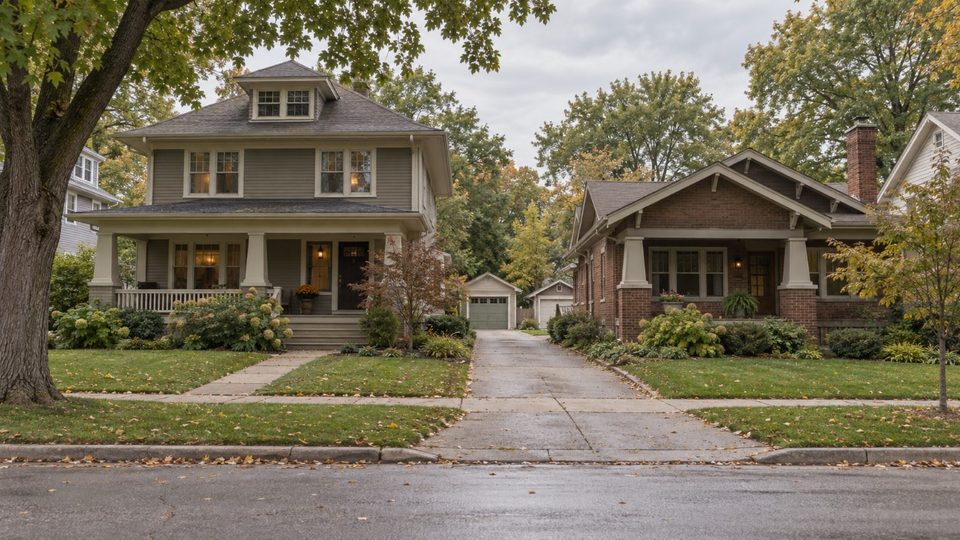
The housing here is largely 1910s to 1930s — foursquares with hipped roofs and deep porches, and bungalows with tapered columns. They were solidly built and generously framed, and their basements were unambiguously not intended as living space: low headroom in places, small windows, rubble or early poured walls.
A great many of those basements were finished anyway, in the 1970s or later, using the assembly that fails everywhere in this county: studs tight against the masonry, fiberglass batts, paper-faced drywall, carpet on the slab. In Riverside that assembly is built against a wall that is colder and considerably wetter than the equivalent wall in a postwar subdivision, so it fails faster and the extent is larger when it is found.
Spring melt and frozen downspouts
A specifically northern failure and a serious one here. Meltwater runs off ground that is still frozen and cannot absorb it, so it arrives at the foundation. At the same time downspouts ice up at the elbow and discharge directly against the wall for weeks. The combination puts a large volume of water against the foundation at exactly the moment the soil can do nothing with it. Downspout extensions and keeping the discharge clear of ice are among the cheapest interventions available in this neighborhood.
Supply lines in exterior walls
Houses of this era frequently have plumbing runs in exterior wall cavities with little or no insulation behind them. A cold snap with the thermostat set back for a weekend away is all it takes. Because the line is in a wall, the water runs inside the cavity rather than across a floor, and it can be days before anybody sees it. See burst supply lines.
What Works Here
- Sump capacity sized for the spring, not the average — and a battery backup
- Downspout extensions discharging well clear of the foundation, kept free of ice
- Grading that falls away from the wall for the first six feet
- A dehumidifier plumbed to the sump or a drain, April to October
- If the basement is finished: rigid foam against the masonry, not studs
- Insulation behind any supply line in an exterior wall
- Storage off the floor, on shelving rather than on the slab
What We Get Called About Most in Riverside
Ranked by how often it comes up, and tied to the buildings that are actually here rather than to mold in general.
- High groundwater close to the riverRiverside sits near the Rock River on the north side, and the water table under it responds to the river within days. Basements that are dry in August take water in March, and a sump that is adequate most of the year is undersized for two weeks of it.
- Foursquares and bungalows with later basement finishingThe housing here is largely 1910s to 1930s, and a great many of the basements were finished in the 1970s or later with studs against the masonry, fiberglass batts and paper-faced drywall. That assembly is wrong for a cold, damp basement in every particular, and it hides the result until the wall is opened.
- Spring melt and frozen downspoutsMeltwater running off frozen ground has nowhere to go but the foundation. Downspouts that ice up at the elbow discharge directly against the wall for weeks.
- Burst supply lines in exterior wallsOlder houses here often have supply runs in exterior wall cavities with little or no insulation behind them. A cold snap with the thermostat set back is all it takes.
Neighborhoods and Sections We Cover in Riverside
Mold Services Available in Riverside
Mold Inspection
Thermal imaging and moisture metering to find the source before anything is opened up.
Basement Mold Removal
The dominant mold problem in Riverside — finished basement walls, limestone and block foundations, and sump failures.
Black Mold Removal
Full containment for water-damage indicator species, plus finding the sustained water source that let it establish.
Attic Mold Removal
Sheathing and rafter growth traced back to ventilation, bath fans or ice damming.
Water Damage & Flood Mold
Frozen and burst lines, sump failures and Rock River flooding — the 24 to 48 hour response window.
Clearance Testing
Independent verification by someone who did not perform the remediation.
What Mold Work Costs in Riverside
General market ranges for south-central Wisconsin, listed for the situations that actually come up in Riverside. These are planning figures rather than quotes — nobody can price a job they have not seen, and what moves a number most is the size of the wet area rather than the stained area. The full cost guide explains what drives each one up or down.
| Work | Typical range | Notes |
|---|---|---|
| Mold inspection with thermal imaging and moisture metering | $250–$600 | Most projects should start here |
| Flooded basement — extraction, removal of wet material, structural drying | $2,500–$8,000 | Before any mold work is priced |
| Unfinished basement clean, treat and dehumidify | $1,200–$3,500 | No finishes to remove |
| Finished basement — wall removal, drying, clearance | $4,000–$12,000 | Excluding reconstruction |
| Burst supply line inside a wall or ceiling | $1,500–$6,000 | Depends how long it ran before it was found |
| Independent post-remediation clearance testing | $400–$900 | Should not be the same firm that did the work |
Prices shown are examples only. For an accurate quote for your specific situation, call (608) 724-1919 — free consultation with a specialist.
Mold FAQ — Riverside, WI
Because that is groundwater rather than rain. Riverside sits close enough to the Rock that the water table under it rises with the river, usually within a few days of the river coming up. In March you also have frozen ground that cannot absorb meltwater, so surface water arrives at the same time. Neither has much to do with rainfall in the previous week, which is why the pattern seems to make no sense. The management is pumping capacity, a backup, and keeping porous material off the floor.
An interior drain tile and sump system manages water that reaches the footing, and on a Riverside property that is frequently worth doing. What it does not do is lower the water table or stop condensation, so be clear which problem you are buying a solution to. If the damp is worst in July, a drainage system will change nothing at all. Get a moisture diagnosis before the sales visit, because the sales visit will not give you one.
Statistically: studs sitting against the masonry, fiberglass batts between them, paper-faced drywall, and probably carpet and pad on the slab. Whether there is growth depends on how wet the wall has been, but the assembly gives it every opportunity. The cheap check is to take a socket cover plate off an exterior-wall outlet and look into the cavity with a flashlight, or pull back a corner of carpet at the wall edge. A moisture meter on the lower two feet of the board tells you more still.
Remediation of a finished basement, excluding reconstruction, runs roughly $4,000 to $12,000 in this market. If there is flood or groundwater history, extraction and structural drying may come first at $2,500 to $8,000. Reconstruction is separate and frequently larger than the remediation. The saving available is in rebuilding correctly — rigid foam against the masonry rather than studs — so that it is not spent again in eight years.
On the low ground here, yes, and a battery backup more so. The two failure modes are a pump that cannot keep up with a river-driven water table and a power cut during the storm that caused the problem. A second pump on a higher float handles the first; a battery or water-powered backup handles the second. Against a $4,000 to $12,000 finished basement remediation, it is inexpensive insurance.