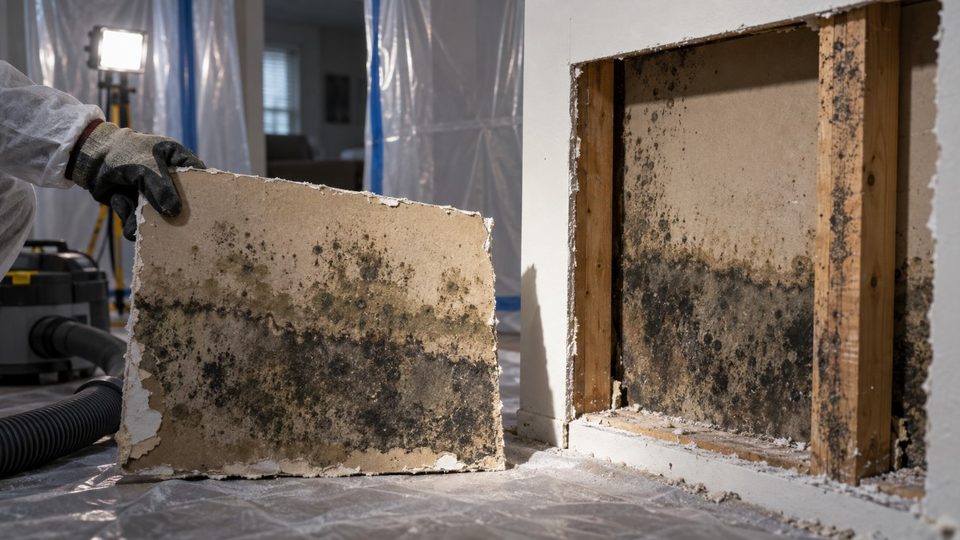
What “Black Mold” Actually Refers To
The phrase usually means Stachybotrys chartarum, a greenish-black species that grows on very wet cellulose — drywall paper, cardboard, wood — and needs sustained moisture rather than occasional dampness. It is a genuine water-damage indicator, and finding it tells you something useful: water has been present for a long time, not overnight.
Two corrections to what circulates online. First, plenty of ordinary, unremarkable species are dark in color, so black growth is not automatically Stachybotrys — and identifying it by eye is not possible. Second, Stachybotrys is not always black; it can appear dark green or almost gray depending on the substrate and how wet it is.
The Institute of Medicine and the World Health Organization both reviewed the evidence and found consistent associations between damp indoor environments and respiratory symptoms, asthma exacerbation, cough and wheeze. Neither found that ordinary indoor exposure to Stachybotrys causes the dramatic outcomes that circulate online. The CDC's position is the same. What that means practically: this is worth correcting properly, urgency rises if anyone in the household is asthmatic or immunocompromised, and panic is not the useful response.
Dark growth you want dealt with
Tell us roughly how large the area is, what material it is on, and how long it has been wet. Those three set the scope. The species does not, and nobody should price a job off the word.
(608) 724-1919Free phone consultation.
Read These, Not the Color
If you want to judge how serious a situation is, these six questions tell you far more than the appearance does.
- Where is it growing?Bathroom grout is a different situation from a wall cavity, whatever color either one is.
- What material is underneath?Paper-faced drywall, cardboard and wood mean cellulose. Tile and concrete do not.
- How long has it been wet?The single most predictive question. Sustained moisture is what distinguishes the indicator species.
- Is it seasonal or constant?Seasonal means condensation. Constant means a leak or groundwater.
- How large is the affected area?The EPA's guidance turns on square footage, not species.
- Is anyone in the household vulnerable?Asthma, allergy, immunosuppression. This changes the urgency, not the method.
Why Containment Matters More Here
Where growth is extensive or has been established a long time, disturbing it releases a great deal of material into the air at once. That is the actual risk during remediation, and it is the reason the work is done under containment with negative pressure rather than by somebody with a bucket. Full containment means sealed barriers, a zippered entry, HEPA-filtered negative air exhausting outside, the HVAC system isolated so nothing travels through the ductwork, and bagged removal.
What Full Containment Looks Like on Site
The word gets used loosely, so here is what it means physically. If you are paying for containment, these are the things to look for while the work is happening.
- A sealed barrier — 6 mil polyethylene taped to floor, walls and ceiling, not a sheet hung across a doorway
- A zippered entry, ideally a two-stage airlock on larger jobs, with a tacky mat inside
- A negative air machine with HEPA filtration, ducted to exhaust outside the building
- Verified negative pressure — the sheeting should visibly pull inward; on larger jobs a manometer reading should be recorded
- The HVAC isolated — supply and return registers in the work area sealed, and the system off or zoned out, so nothing travels through the ductwork
- Bagged removal — material double-bagged and wiped down inside containment before it leaves
- Operatives in disposable coveralls and respirators, with the PPE removed inside the containment
A crew working an established black mold job in ordinary clothes with a box fan in the window is not doing any of this, and the distribution of material through the rest of the building is the predictable result.
Why disturbance is the risk moment
Living beside an undisturbed patch of growth behind a wall exposes you to very little. Cutting into it releases a large quantity of spores and fragments at once, into a volume of air you are standing in. That asymmetry is the entire justification for containment, and it is why the advice to a homeowner who finds a large area is to stop, close the door, and not investigate further with a scraper.
What happens to contents
| Item | Usual outcome |
|---|---|
| Hard goods — glass, metal, sealed plastic, finished wood | HEPA vacuumed and wiped, kept |
| Clothing and washable textiles | Laundered normally, kept |
| Upholstered furniture that was in contact | Specialist cleaning, or disposal on cost grounds |
| Books and paper | Rarely economic unless the item is irreplaceable |
| Mattresses and pillows | Disposal |
| Electronics | Usually cleanable by a specialist; do not power them on first |
A contractor proposing to dispose of everything in the room is not making a technical judgment, and one proposing to keep a saturated mattress is not either.
Finding the Water That Allowed It
Sustained moisture is the defining requirement, so Stachybotrys is nearly always a symptom of something specific rather than of general dampness. In Rock County housing the recurring causes are a long-running plumbing leak inside a wall, a basement that has been wet for successive springs, material left in place after a flood, and a roof or ice-dam leak that has been wetting the same spot each winter for years. Remediating without finding which of those it was means doing it again.
Frequently Asked Questions
The evidence supports a real but more modest picture than the internet does. Damp indoor environments are consistently associated with respiratory symptoms, cough, wheeze and asthma exacerbation — that is the finding of both the Institute of Medicine and the WHO. Claims of severe neurological illness from ordinary household exposure are not supported by those reviews. If somebody in the house is asthmatic, allergic or immunocompromised, treat it as more urgent. Otherwise: fix it properly, do not panic.
No, and nobody can. Identification requires a sample and a microscope. In practice it usually does not matter, because the response is decided by the extent of the growth and the amount of water, not by the species. A tape lift is inexpensive if you want the record — for a dispute, an insurance claim or peace of mind — but it rarely changes the scope of work.
It is priced by the affected area and the containment required, not by the species. A small contained area runs $500 to $1,500; a single room $1,200 to $3,800; a finished basement $4,000 to $12,000. What lifts a black mold job above the equivalent ordinary one is usually that it has been wet longer, so more material is affected. Anyone charging a premium purely for the word “black” is selling the word.
Under about ten square feet on a hard, non-porous surface, yes — detergent and water, gloves, an N95, and thorough drying. Beyond that, or on porous material, or inside a wall or an HVAC system, no. The reason is not that the species is uniquely hazardous; it is that disturbing established growth without containment distributes it through the rest of the building, and that a large area means a lot of water you have not yet found.
No. Porous material that has been wet long enough to colonize comes out — drywall, insulation, carpet pad, ceiling tile. Hard surfaces clean. Contents are case by case: books, papers and soft furnishings that have been in contact are often not worth specialist cleaning, while hard goods almost always are. A contractor who wants to dispose of everything in the room is not making a technical judgment.