Warm-Climate Advice Gets This Exactly Backwards
Most of what is written online about wall cavity moisture assumes a cooling climate, where the outdoor air is hot and humid and the indoor air is cool and dry. In that situation the vapor drive runs inward, and the vapor barrier goes on the outside face of the insulation.
In southern Wisconsin, for roughly five months of the year, the situation is reversed. The indoor air is warm and carries water; the outdoor air is cold and carries very little. Vapor moves from high concentration to low, which means outward — from your living room, through the wall, toward the outside. That is winter vapor drive, and it is the mechanism behind most concealed wall and roof mold in this climate.
Have a specific situation?
This article covers the general case. For your own building, call and describe what you are seeing. The conversation is free.
(608) 724-1919Free phone consultation.
Where It Condenses
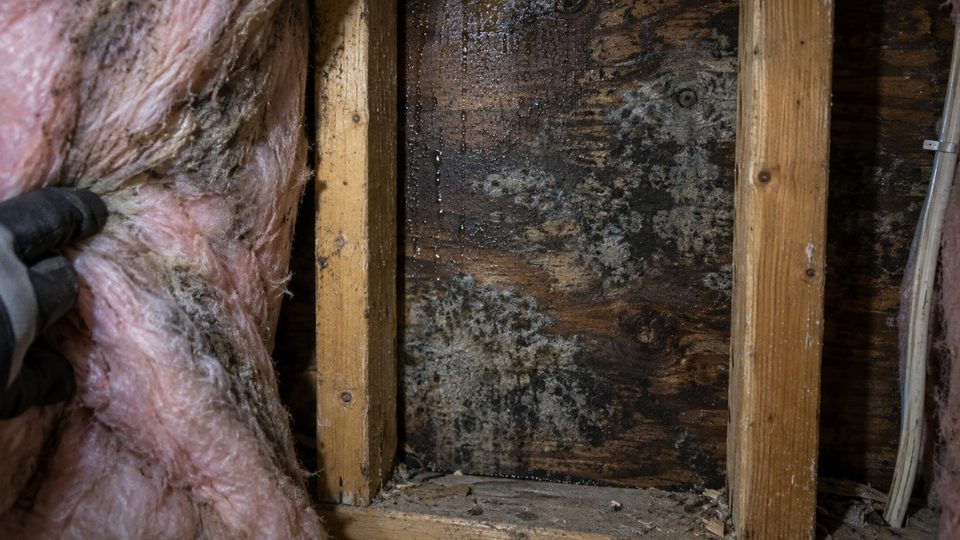
Moisture moving outward through a wall meets progressively colder material. At some point in that journey it reaches a surface below its dew point and turns into liquid. In a standard insulated stud wall, that surface is the back face of the exterior sheathing.
The sheathing is plywood or OSB, it is cold because it is on the outside of the insulation, and it is organic. Water condensing on it repeatedly, over a season, gives you exactly the conditions growth needs — in a location nobody will look at until the wall is opened for some other reason.
The condensation happens from December through March. By May the wall has dried and there is nothing to find with a moisture meter. Any staining that develops takes months to work through to a visible surface, so it is noticed in summer — when the mechanism that caused it has been dormant for months and nothing you observe will explain it. This is why "it was dry when I checked" is not evidence of anything in a cold climate.
How the Moisture Gets Into the Wall
Two routes, and their relative importance is the single most useful thing in building science that homeowners are rarely told.
- Vapor diffusion — slowWater vapor migrating through solid materials by molecular diffusion. Real, but gradual, and it is what a vapor retarder addresses.
- Air leakage — fastMoist indoor air physically flowing into the cavity through gaps: around outlets, at the top and bottom plates, around wiring and plumbing penetrations, at the attic hatch. This moves orders of magnitude more water than diffusion does.
The practical consequence: air sealing matters far more than vapor barriers. A wall with a perfect vapor retarder and a two-inch gap around a ceiling penetration will fail. A well air-sealed wall with an ordinary vapor retarder generally will not. If you can only do one thing, seal the air paths.
Signs You Have It
- Staining on attic sheathing, particularly the north-facing plane, appearing in summer
- Dark nail points on the underside of the roof deck — condensation forming on the coldest metal first, and an early-stage sign
- Frost on the inside of the sheathing during a deep freeze, if you go up and look at the right moment
- A musty smell from an exterior wall with no visible source
- Damp insulation found during unrelated work
- Peeling exterior paint in a band, sometimes, where moisture is pushing out through the siding
What to Do About It
- Air seal the ceiling plane first. Attic hatch, recessed lights, plumbing and wiring penetrations, the top plates of interior walls, and any chase around a chimney or stairwell. Highest return of anything on this list.
- Reduce indoor humidity in winter. 30 to 35 percent when it is 0 to 20°F outside, 25 to 30 percent in a deep cold snap. Turn the furnace humidifier down, and off by March.
- Run bath and kitchen exhaust properly — twenty minutes after a shower, and terminating outside.
- Balance the attic ventilation so the roof space is not sitting still all winter.
- Insulate and air seal the rim joist, which is the same mechanism at the bottom of the building.
- Do not add a second vapor barrier in a retrofit without understanding the assembly — two barriers with insulation between them traps moisture between them.
Why New Houses Are Not Exempt
A tight modern envelope reduces air leakage into the wall, which helps considerably with this specific mechanism. But it also means household moisture has no route out of the building unless mechanical ventilation provides one. Without a working HRV or ERV, indoor humidity in a new Janesville house climbs through the winter, and that raises the vapor pressure driving moisture into whatever small leakage paths remain. Different failure, same physics.
Questions This Article Raises Most Often
In this climate a vapor retarder on the warm side of the insulation is conventional and code-compliant, and in new construction that is generally what you will find. The thing worth knowing is that it is the less important half of the job. Air sealing prevents far more moisture from entering the cavity than any vapor retarder does. And in a retrofit, adding polyethylene to a wall that already has a low-permeability layer on the outside can trap moisture between the two, which is worse than either alone.
Because that plane gets the least sun, so it stays colder for longer and spends more hours below the dew point of the air reaching it. South-facing sheathing warms during the day even in winter and dries out. It is a useful diagnostic: staining concentrated on the north plane points at general air leakage and ventilation rather than at a localized source like a duct or a leak, which would produce a defined patch wherever it happens to be.
Not on its own, and doing so without air sealing first frequently makes this specific problem worse. More insulation keeps the sheathing colder, so the same moisture arriving condenses more readily. Added depth also commonly buries soffit intakes, which stops the ventilation that would otherwise carry moisture away. The correct order is air seal, then baffles to keep the intake clear, then insulate to depth.
A blower door test with an infrared camera is the thorough answer and is worth it if you are doing substantial work. Without one, the usual suspects account for most of it: the attic hatch, recessed light fittings, the tops of interior partition walls, every plumbing and wiring penetration, and the chase around a chimney. Go into the attic on a cold day and look for frost, discolored insulation, or places where the insulation has been disturbed by moving air — those mark leaks.
Same physics, opposite direction, different season. In summer, humid outdoor air meets cold basement masonry and condenses on a surface you can see. In winter, humid indoor air moves outward into the assemblies and condenses on surfaces you cannot. Both are condensation rather than leaks; both are solved by controlling humidity and air movement rather than by waterproofing. A Janesville house generally has both, at different times of year.