The Defining Mold Problem in Rock County
Nearly every house in Janesville has a full basement, and in a cold, humid climate that masonry box spends the year caught between two opposite pressures. Understanding which one is acting on your wall this month is most of the diagnosis.
Summer: the wall is colder than the air
A buried foundation wall here sits at roughly deep-earth temperature all year, in the low to mid 50s Fahrenheit. From June through September, outdoor dew points in southern Wisconsin regularly run into the 60s for weeks at a time. Humid air reaching that wall is already below its dew point and deposits liquid water on it. No leak is involved. This is the single largest cause of basement mold in the county, and it is the reason opening the basement windows in July makes the problem worse rather than better — you are importing the moisture.
Winter: the air is warmer than the wall
The direction reverses. Warm, moist indoor air pushes outward and condenses inside the assemblies — on the back of a finished basement wall, on the rim joist sitting on top of the foundation, on cold supply lines. The rim joist is the specific Wisconsin case: it is the coldest wood in the building through a long freeze, it is almost always packed with a bare fiberglass batt, and nobody ever looks at it.
Spring: the ground is the problem
Frozen ground cannot absorb meltwater, so it runs to the foundation. Downspouts that ice up at the elbow discharge directly against the wall for weeks. And on the low ground — Blackbridge, Riverside, Traxler Park, Afton, the downtown blocks — the water table follows the Rock River within days of the river rising.
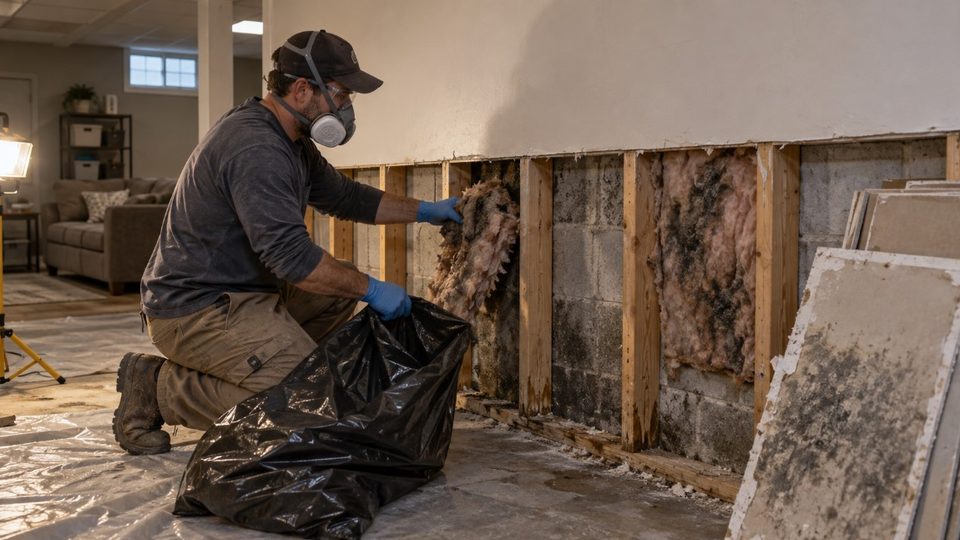
Stud wall built tight against cold masonry, fiberglass batts between the studs, paper-faced drywall over it, carpet on the slab. Every element is wrong here: the masonry runs cold, fiberglass stops neither air nor vapor, it holds moisture against the back of the board, the paper facing is cellulose, and the whole assembly is hidden. Growth runs on the concealed face for years before anything reaches the room, and the first sign is usually smell.
Groundwater, or condensation?
Tell us which month the damp appears in and whether the wall is finished. That single answer separates a dehumidifier job from a drainage job, and the two are nowhere near the same price.
(608) 724-1919Free phone consultation.
Finished Versus Unfinished
| Unfinished basement | Finished basement | |
|---|---|---|
| How you find out | You can see it | Smell, allergy symptoms, or a renovation |
| Typical delay before discovery | Weeks | Years |
| Extent when found | What you see | Usually several times what you see |
| Typical cost here | $1,200–$3,500 | $4,000–$12,000 |
| Reconstruction after | None | Often more than the remediation |
Prices shown are examples only. For an accurate quote for your specific situation, call (608) 724-1919 — free consultation with a specialist.
What the Work Involves
- Establish which mechanism it isSeasonal pattern, dew point measurement, and the location of the wettest readings. Condensation, groundwater and plumbing all need different corrections.
- Correct the water firstGutters, downspout extensions, grading, sump capacity and backup. Sometimes this is the entire job.
- Contain and removeFinished walls opened past the wet boundary, insulation and paper-faced board bagged out, bottom plates assessed.
- Clean and dry to targetHEPA vacuum, detergent clean, then dehumidification with daily readings logged against an unaffected reference.
- Verify independentlyVisual, moisture, then air against an outdoor control.
- Rebuild differentlyRigid foam against the masonry, framing in front of the foam, paperless board, no carpet directly on the slab.
The Rebuild That Does Not Repeat the Failure
This is the part most worth getting right, because rebuilding the original assembly schedules the same job again in five years. What works in this climate:
- Correct the exterior water before anything goes back
- Rigid foam board directly against the masonry, sealed at the joints — this keeps the back of the framing above dew point
- Frame in front of the foam, not against the wall
- Paperless or fiberglass-faced board below grade
- No carpet or pad directly on the slab; use an insulated subfloor or a hard finish
- A dehumidifier plumbed to the sump or a floor drain, running April to October
- Air-seal and insulate the rim joist properly while the space is open
Radon, While the Basement Is Open
Rock County is an EPA Radon Zone 1 county and roughly half of homes tested here come back at or above the action level, with three Janesville ZIP codes among the highest in the state. Radon enters through the same slab-to-wall joint, cracks and sump pit that moisture does. If a basement is being opened up anyway, that is the cheapest moment in the building's life to deal with both. See radon and mold in Rock County.
Frequently Asked Questions
Almost certainly not, and this is the most common misdiagnosis in the county. That seasonal pattern is the signature of condensation, not intrusion. A buried foundation wall here sits in the low to mid 50s all year; from June to September the outdoor dew point runs into the 60s. Humid air reaching that wall is already below its dew point and deposits water on it. A leak does not behave that way. The fix is not waterproofing — it is closing the basement to outdoor air and running a correctly sized dehumidifier plumbed to a drain, set to 45 to 50 percent, from April through October.
An unfinished basement clean, treat and dry runs roughly $1,200 to $3,500. A finished basement, excluding reconstruction, runs roughly $4,000 to $12,000. The gap is almost entirely the cost of opening up and disposing of finishes, plus the fact that a concealed problem is usually far more extensive by the time it is found. Reconstruction is separate and frequently larger than the remediation. See the cost guide.
Only after establishing that water is actually coming through the wall. Interior waterproofing systems are sold hard in this region and they solve exactly one of the six common moisture sources. If the damp is summer condensation, a waterproofing system does nothing at all, because the water is condensing out of the indoor air rather than arriving through the masonry. Get the diagnosis before the sales visit, not after.
Yes, provided it is done in the right order and with the right assembly. Correct the exterior water, test for radon, confirm the space stays dry through a full seasonal cycle, then build with rigid foam against the masonry rather than a stud wall tight to it, and use paperless board below grade. What fails is finishing over an unresolved moisture problem with materials that feed mold. That is not an argument against finished basements; it is an argument against that specific assembly.
No — that is efflorescence, mineral salt left behind as water evaporates out of the masonry. It is not growth and it is not harmful. What it is, is proof that liquid water is moving through the wall and evaporating on the inside face. So it is genuinely useful information: it tells you the mechanism, and it tells you roughly how high the water is reaching.