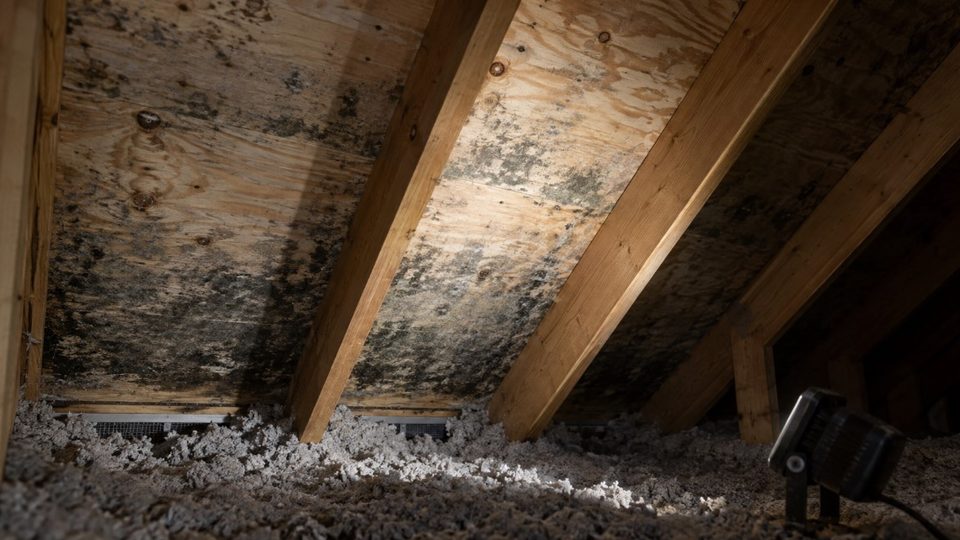
Attic Mold Is Always a Ventilation or Air-Leakage Story
There is no such thing as an attic with a mold problem and no moisture problem. In a Wisconsin winter the mechanism is nearly always the same: warm, moist air from the house gets into a cold roof space, meets sheathing that is close to outdoor temperature, and condenses on it. Repeat that for four months a year and the sheathing stains.
The timing is what confuses people. The damage is done between December and March. The staining is usually noticed in June, when somebody goes up for a box. By then the mechanism has stopped for the season, which is why "it looks dry up there" is not evidence of anything.
Dark staining on the sheathing?
Tell us where it is — along the eaves, up at the ridge, or one patch above the bathroom. The pattern usually identifies ventilation, an exhaust duct or a roof leak before anyone goes up there.
(608) 724-1919Free phone consultation.
Five Real Causes, in Order
- Air leakage through the ceiling planeRecessed lights, the attic hatch, plumbing and wiring penetrations, the top plates of interior walls, and the chase above a chimney or a stairwell. This is the biggest one and the least visible.
- Bath fans venting into the atticOr into a soffit that feeds straight back in. Produces a distinct dark cone on the sheathing directly above the bathroom.
- Blocked or unbalanced ventilationSoffits buried when insulation was topped up, or a ridge vent added with no intake to feed it. Air stops moving and the deck runs cold and damp.
- Ice dammingMeltwater refreezing at the cold eave, backing up under the shingles, and wetting the top plate and the wall cavity below. A specifically northern failure.
- Roof leaksActual holes. Less common than the other four, and the only one most people think of.
A re-roof addresses cause five and frequently makes causes three and four worse, because new shingles and a ridge vent get installed without anyone correcting the intake ventilation or air sealing the ceiling. It is genuinely common here for staining to appear the winter after a roof replacement. If a roofer tells you new shingles will solve attic mold, they are answering a different question.
What the Work Involves
- Contain and set up negative pressure before anything is disturbed — an attic connects to the whole house
- Remove contaminated insulation where it is wet or has been wet
- HEPA vacuum and clean the sheathing and rafters; soda or dry-ice blasting where staining is heavy
- Treatment after cleaning where warranted
- Air-seal the ceiling plane — this is the part that actually prevents recurrence
- Correct the ventilation: clear soffits, install baffles, balance intake against exhaust
- Reroute any exhaust duct that terminates in the attic
- Re-insulate to depth once the assembly is dry
- Optional encapsulation coating on cleaned sheathing
Ventilation, as a Calculation Rather Than an Opinion
Attic ventilation has an actual specification, and quoting it is how you tell whether a contractor is guessing.
The conventional requirement is 1 square foot of net free ventilation area for every 150 square feet of attic floor, reducible to 1 in 300 where a vapor retarder is present on the warm side or where the ventilation is balanced between high and low. Note the phrase net free area — a vent's physical opening is not its NFA, because louvers and insect screen reduce it, typically by half or more. The manufacturer publishes the NFA per unit; the arithmetic uses that figure, not the hole size.
The second half matters more than the total: intake and exhaust should be roughly balanced, with at least half the area at the eaves. A ridge vent with inadequate soffit intake does not simply underperform — it can pull air from the house through ceiling leaks instead, which is the opposite of what you wanted.
Baffles, and why insulation depth defeats ventilation
Blown insulation at full depth will bury the soffit intakes unless something holds the channel open. Rafter baffles — cardboard, foam or plastic chutes stapled between the rafters at each bay — maintain a clear air path from the soffit up past the insulation. They cost very little and they are omitted constantly. If insulation was topped up and the attic got worse, this is usually why.
Air sealing: the list, in order of leakage
- The attic hatch or pull-down stairFrequently the single largest hole in the ceiling plane. Weatherstrip it and insulate the back of it.
- Recessed light fittingsOlder non-IC fittings leak continuously. Replace with airtight IC-rated units or build sealed boxes over them.
- Top plates of interior partition wallsThe gap between plate and drywall runs the length of every wall. Caulk or foam it.
- Plumbing and wiring penetrationsFoam around each.
- Chimney and flue chasesSealed with sheet metal and high-temperature sealant, never with foam directly against a flue.
- Bath fan housingsThe housing itself is a leak quite apart from where the duct goes.
Cleaning methods, and when each is used
| Method | Used for | Notes |
|---|---|---|
| HEPA vacuum and detergent wipe | Light surface growth | Adequate for most attics caught early. Slow over large areas. |
| Soda blasting | Heavier staining on sheathing | Sodium bicarbonate media, non-abrasive to wood. Leaves a residue that must be vacuumed out thoroughly. |
| Dry ice blasting | Heavy staining where residue is a problem | The media sublimates, so nothing is left but the removed material. More expensive; no water introduced. |
| Encapsulation coating | After cleaning, on stained-but-sound sheathing | Locks down residual staining and gives a clean reference surface. Never instead of cleaning. |
| Sheathing replacement | Delamination or structural loss only | Rarely warranted. Expensive way to solve a ventilation problem. |
Reading the Stain Pattern
| Pattern | Usually means |
|---|---|
| Even gray haze across the north-facing plane | General air leakage plus inadequate ventilation. The classic case. |
| Dark cone above one spot | An exhaust duct discharging there. |
| Staining concentrated at the eaves | Blocked soffit intake, or ice damming. |
| Staining around a penetration | Air leakage at that penetration, or a genuine leak. |
| Black along the nail points only | Condensation on the coldest metal. Early-stage; correct the ventilation and it stops. |
| A defined stain with a hard tide line | A liquid leak rather than condensation. |
Frequently Asked Questions
Cleaning, treatment and re-insulation typically runs $2,800 to $7,500 in this market, depending on the area, the access and how much insulation has to come out. Ventilation correction and ceiling air sealing are usually separate line items and are the part that stops it returning, so it is worth having them priced rather than deferred. An encapsulation coating on cleaned sheathing adds roughly $1,000 to $3,500.
Rarely. Plywood and OSB are dense enough that growth sits on the surface and cleans off, and structural replacement is only warranted where the material has delaminated or lost strength. Removing and replacing sheathing is a very expensive way to solve a ventilation problem, and it is occasionally quoted as though it were the standard approach. Ask why, and ask what the moisture readings are.
On its own, frequently not, and it can make things worse. Adding depth without air sealing the ceiling plane first keeps the attic colder while the same moist air keeps arriving, which increases condensation. Worse, blown insulation regularly buries the soffit intakes, which is one of the five causes. The order is: air seal, install baffles to keep intake clear, then insulate to depth.
Go up with a flashlight on a dry day, ideally in late winter when the mechanism is active. Look at the underside of the sheathing, particularly on the north-facing plane and near the eaves. Look for dark patches, frost, or damp nail points. Follow every duct you can see to where it actually terminates. Check whether you can see daylight at the soffits or whether insulation has buried them. Fifteen minutes answers most of it.
Less than an equivalent amount in living space, because in a cold climate the net air movement is upward — air generally travels from the house into the attic rather than the other way. That is not a reason to leave it: the same air leaks that carry moisture up will carry particles down whenever the pressure balance reverses, such as when an exhaust fan runs. It also means the real problem is the air leakage itself, which is worth fixing for several reasons at once.