Water First, Mold Second
Every mold job that starts with water is decided in the first two days. Get the water out, open the assemblies and dry the structure to a measured target inside that window, and there frequently is no mold job. Miss it, and the same building becomes a removal project at several times the cost.
Has water been standing since yesterday?
Then call today rather than after the weekend. Everything that can be dried and kept is decided in the first 48 hours; after that the same material becomes something that has to be removed.
(608) 724-1919Free phone consultation, answered 24/7.
The Four Ways Water Arrives in Rock County
| Source | Season | What makes it worse here |
|---|---|---|
| Frozen and burst supply lines | December–March | Usually in an exterior wall or unheated space, so the water runs inside a cavity unseen — and often while nobody is in the building. |
| Sump pump failure | February thaw, spring rain | Meltwater arrives faster than a tired pump can move it, and storms bring power cuts at the same moment. |
| Rock River flooding and high groundwater | March–June | On the low ground the water table follows the river within days. June 2008 put water into basements across the county. |
| Appliance and plumbing failures | Any | Water heaters, washer hoses, dishwashers — frequently on a finished lower level where it runs behind the appliance for months. |
The Three Categories of Water
This is the classification that decides what gets saved, and it is worth knowing because contractors use the terms without explaining them.
- Category 1 — clean waterA supply line, a water heater, rainwater. Most material is savable if drying starts quickly. It degrades to Category 2 within about 48 hours.
- Category 2 — gray waterAppliance discharge, washing machine overflow, sump overflow. Porous material is generally removed; hard surfaces clean.
- Category 3 — black waterSewage backup, river flood water, anything that has been standing long enough to become biologically active. All porous material comes out, full stop, and the work is done under containment.
River flood water is Category 3. That matters, because the most common mistake after a flood is treating it like a big Category 1 event — pumping it out, running fans for a week, and leaving the drywall and insulation in place because they feel dry.
The flood was the event; the mold was what happened in the eight weeks afterwards. Across the Rock River communities, a great many basements were pumped out, dried with fans and put back together with the original wet drywall and insulation still in the wall. It felt dry, the surface looked fine, and eighteen months later the same houses had a musty basement nobody could account for. If your property took water in 2008 and the finishes were never removed, that history is worth mentioning on the call.
Structural Drying, Properly Done
- Extraction first — every gallon pumped out is a gallon that does not have to be evaporated
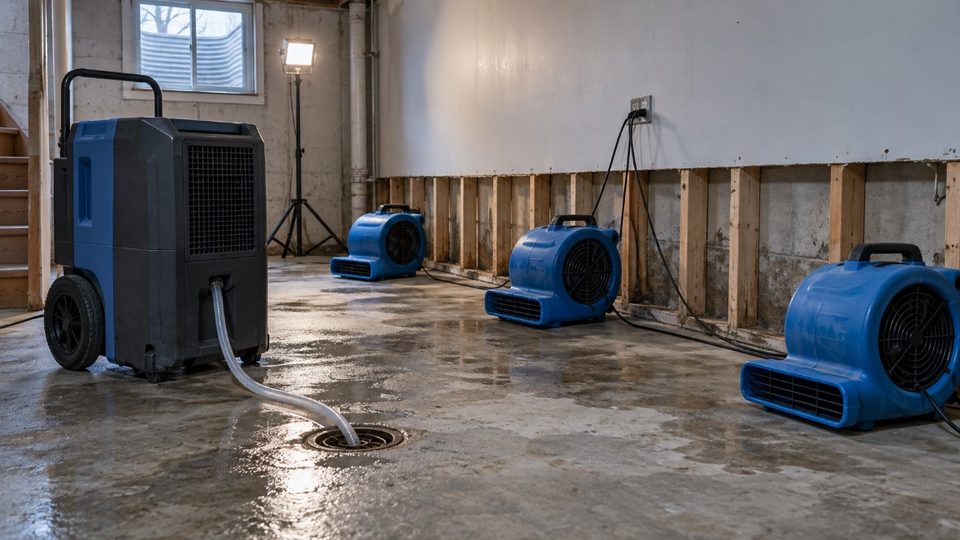
- Controlled removal of finishes so the structure is actually exposed to the air being moved
- Air movers positioned to create surface airflow, not just noise
- Dehumidification sized to the volume, running continuously
- Daily moisture readings logged against an unaffected reference area
- Temperature maintained — drying in a cold Wisconsin basement is slow, and turning the heat off to save money stops it altogether
- A documented end point, not a decision made by looking
The Drying Plan, and What to Ask to See
Structural drying is a measured process, not a matter of leaving fans running until somebody decides it looks dry. On any job worth the name there is a daily record, and you are entitled to see it.
| Recorded daily | Why it matters |
|---|---|
| Moisture content at fixed marked points | The same spots each day, so the trend is real rather than a different spot each visit |
| Reference reading from an unaffected area | This is what the target is set against |
| Temperature and relative humidity in the drying chamber | Shows the equipment is actually creating drying conditions |
| Outside temperature and humidity | Context, and it explains a slow day |
| Equipment in place and running hours | Also what the invoice is based on |
A flat trend over two consecutive days with the equipment running means something is wrong — usually a closed cavity that air is not reaching, or too little heat. That is the moment to open something further rather than to keep waiting.
Why winter drying is slower here, and what to do about it
Evaporation depends on temperature, and a Janesville basement in February is cold. Two consequences. First, the space has to be heated to dry — turning the heat down to save money stops the process, and a contractor who accepts an unheated space is not going to reach target. Second, refrigerant dehumidifiers lose capacity below roughly 65°F, so in a cold basement a desiccant unit does considerably more work. If a winter job is dragging, those two things are usually why.
Frozen Pipe Losses in Particular
The most common significant water loss in this county, and it behaves differently from a floor-level flood.
- The water goes into the wall cavity rather than across the floor, so the visible area understates the wet area badly
- It runs downward and sideways along framing — check the level below, and the ceiling under it
- Insulation in the cavity holds water against the framing and cannot be dried in place; it comes out
- The split is often downstream of where the ice formed, so the pipe damage and the water damage are in different places
- If the property was unoccupied, check the policy's unoccupancy terms before assuming cover
Category degradation, and why the clock matters twice
Clean supply water starts as Category 1 and degrades to Category 2 within roughly 48 hours as it takes up material from what it has soaked into. So the 48-hour window is not only about mold growth — it is also the point at which material that could have been dried and kept becomes material that should be removed. Two clocks, running together, which is why the response on day one is worth so much more than the response on day four.
What Insurance Usually Does and Does Not Cover
A Wisconsin homeowners policy generally covers sudden and accidental water — a burst supply line is the textbook case. It generally excludes long-term seepage, groundwater, and surface flooding. Flood requires a separate NFIP or private flood policy, and that distinction is exactly where Rock River properties get caught: river water is flood, not a covered water loss. Mold arising from a covered loss is frequently subject to a capped endorsement, often $5,000 to $10,000. See the Wisconsin insurance article.
Frequently Asked Questions
If the water was from the river or a sewer backup, yes — that is Category 3 and porous material comes out regardless of how dry it feels. If it was clean water and drying started within about 48 hours, often not. The test is whether the material can be dried to a documented moisture target, and whether the water was clean. What does not work is deciding by touch: drywall that feels dry on the face can be holding water in the core and behind the paper.
Typically three to seven days for a residential water loss, longer in a cold basement in winter because low temperature slows evaporation considerably. Anyone promising a finished basement dried in 48 hours is either not drying to a target or had very little water to begin with. The honest answer is that it takes as long as the readings take to come down, which is why daily logs matter.
A flooded basement — extraction, removal of wet material and structural drying — typically runs $2,500 to $8,000 in this market before any mold work or reconstruction. A burst supply line inside a wall runs $1,500 to $6,000, and the range is that wide almost entirely because of how long it ran before it was found. See the cost guide.
Almost certainly not. Surface flooding and rising groundwater are standard exclusions on a homeowners policy in Wisconsin and everywhere else; flood coverage comes from a separate NFIP policy or a private flood product. This catches out Rock River properties regularly, because the water that entered came from the river rather than from anything that failed inside the house. A burst pipe in the same basement would usually be covered.
Possibly not, and it depends on two things: what category the water was, and whether anything porous stayed wet for more than about two days. If it was clean water, it was extracted quickly, and nothing is reading elevated on a moisture meter, you are probably done. If it was river or sewer water, or if drywall and insulation were wet for days, looking fine is not the test. A moisture survey is inexpensive next to finding out in eighteen months.