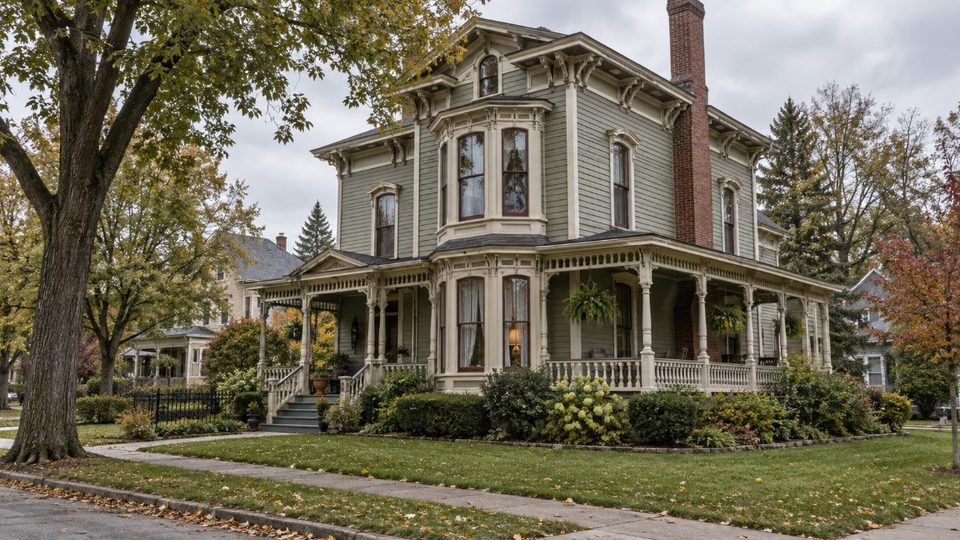
One of the Better-Preserved Victorian Districts in the County
Evansville has an unusually intact nineteenth-century residential district, and for anyone who cares about old buildings that is a good thing. For moisture it means a concentration of the specific problems that come with that period: limestone and brick cellars, plaster and lath, balloon framing, and single-glazed original windows.
Serving Evansville, WI
Call and tell us what is happening in your Evansville property. A specialist will talk it through with you — free, and with no obligation.
(608) 724-1919Free phone consultation.
The Most Damaging Thing Is Restoration Done Wrong
This is worth stating plainly, because Evansville has more careful owners than most places and the damage is nearly always well-intentioned. A modern impermeable coating or a Portland cement repoint applied to a nineteenth-century masonry wall does not stop water entering. It stops it leaving.
The consequence in a freeze-thaw climate is not subtle. Moisture that used to evaporate through the mortar joint now leaves through the face of the stone or brick instead, and when it freezes there it spalls the material. A joint can be repointed; a spalled stone face cannot be put back. Lime mortar matched to the original, and vapor-open finishes or none at all, are the correct approach.
Balloon Framing and What It Connects
Stud cavities running uninterrupted from the sill to the attic give moist cellar air a direct path into every exterior wall and into the roof space. It is the reason a damp cellar in a house of this period produces staining two floors up, and the reason treating the cellar and the attic as separate problems misses the mechanism connecting them. Air sealing at the top of those cavities is one of the higher-value interventions available in this housing.
Original Windows and Sill Rot
Single glazing in a Wisconsin winter runs with condensation. The water collects on the sill, the paint film holds it there, and the sill rots from underneath while looking sound on top. Storm windows help considerably; so does keeping indoor humidity lower than most people find intuitive — 25 to 30 percent when it is very cold outside. If you can see water on the glass every cold morning, the house is too humid for the weather.
Later Kitchens and Bathrooms
Wet rooms added to houses that were built without them, usually on an outside wall with minimal insulation and an extract fan that discharges into a soffit or simply into the ceiling void. In a house with balloon-framed walls that moisture has an easy route into the structure.
What We Get Called About Most in Evansville
Ranked by how often it comes up, and tied to the buildings that are actually here rather than to mold in general.
- A large intact stock of Victorian housingEvansville has one of the better-preserved nineteenth-century residential districts in the county. That means limestone and brick cellars, plaster and lath, and balloon framing that connects the cellar to the roof.
- Restoration work that seals a breathable wallThe most damaging thing that happens to these buildings is a modern impermeable coating or a cement repoint. It does not stop water entering; it stops it leaving.
- Original windows and sill rotSingle glazing in a cold climate runs with condensation all winter. The water lands on the sill, and the paint film holds it there.
- Later kitchen and bathroom additionsWet rooms added to houses that had none, often on an outside wall with minimal insulation and an extract fan that discharges into a soffit.
Neighborhoods and Sections We Cover in Evansville
Mold Services Available in Evansville
Mold Inspection
Thermal imaging and moisture metering to find the source before anything is opened up.
Basement Mold Removal
The dominant mold problem in Evansville — finished basement walls, limestone and block foundations, and sump failures.
Black Mold Removal
Full containment for water-damage indicator species, plus finding the sustained water source that let it establish.
Attic Mold Removal
Sheathing and rafter growth traced back to ventilation, bath fans or ice damming.
Water Damage & Flood Mold
Frozen and burst lines, sump failures and Rock River flooding — the 24 to 48 hour response window.
Clearance Testing
Independent verification by someone who did not perform the remediation.
What Mold Work Costs in Evansville
General market ranges for south-central Wisconsin, listed for the situations that actually come up in Evansville. These are planning figures rather than quotes — nobody can price a job they have not seen, and what moves a number most is the size of the wet area rather than the stained area. The full cost guide explains what drives each one up or down.
| Work | Typical range | Notes |
|---|---|---|
| Mold inspection with thermal imaging and moisture metering | $250–$600 | Most projects should start here |
| Unfinished basement clean, treat and dehumidify | $1,200–$3,500 | No finishes to remove |
| Small contained area — one wall section, a closet, behind a water heater | $500–$1,500 | Under roughly 10–30 sq ft |
| Single room | $1,200–$3,800 | Containment, removal, drying, clearance |
| Attic remediation with cleaning, treatment and re-insulation | $2,800–$7,500 | Ventilation correction usually extra |
| Independent post-remediation clearance testing | $400–$900 | Should not be the same firm that did the work |
Prices shown are examples only. For an accurate quote for your specific situation, call (608) 724-1919 — free consultation with a specialist.
Mold FAQ — Evansville, WI
No, not on a nineteenth-century masonry wall. Portland cement is harder and less vapor-permeable than the original stone or soft brick and than the lime mortar it replaces. The result is that moisture which used to exit through the sacrificial joint exits through the face of the masonry instead, and in a freeze-thaw climate that spalls it. A joint is repairable; a spalled face is not. Ask for lime mortar matched to the original, and find a mason who works on historic buildings if the first one disagrees.
In a balloon-framed house that is a familiar pattern. The stud cavities run uninterrupted from the cellar to the attic, so moist cellar air travels up inside the wall and condenses where the assembly is coldest, which is usually high up. Fixing the roof will not touch it. What helps is controlling the cellar humidity, air sealing the top and bottom of those cavities to interrupt the path, and correcting whatever is wetting the cellar in the first place.
From a moisture standpoint, storm windows plus lower indoor humidity solve most of what replacement would, at a fraction of the cost and without losing the original joinery. Condensation on single glazing is a symptom of indoor humidity being too high for the outdoor temperature as much as it is of the glass. If the sills are already rotting, that is a repair job rather than an argument for replacement — and sill repair on a good original window is usually straightforward.
The published ranges apply, but with a caveat: on a historic building the cost driver is usually care and access rather than area. Work that has to avoid damaging original plaster, joinery or masonry takes longer than the equivalent job in a postwar house. An unfinished cellar clean and dehumidify runs $1,200 to $3,500; attic work $2,800 to $7,500. Get a scope in writing that says explicitly what will and will not be disturbed.