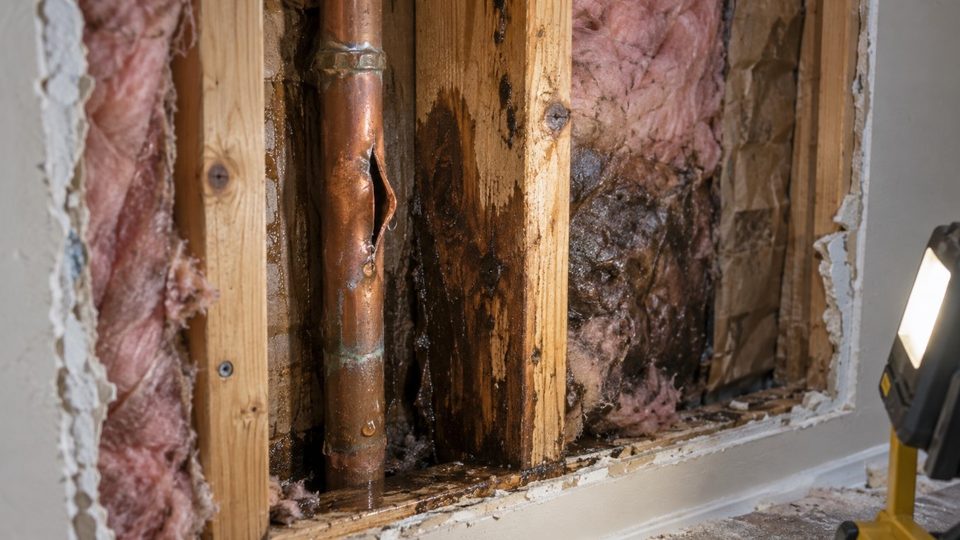
Why It Is Nearly Always an Exterior Wall
Pipes freeze where the cold reaches them, and in a Wisconsin house that means the runs that are on the wrong side of the insulation: supply lines in exterior wall cavities, lines crossing an unheated crawl space, plumbing in a garage wall, and anything serving an outside tap.
Older Janesville housing is particularly exposed, because plumbing was frequently run in exterior walls when it was installed and nobody was thinking about insulation behind it. A 1920s foursquare with a bathroom on an outside wall has the problem built in.
Have a specific situation?
This article covers the general case. For your own building, call and describe what you are seeing. The conversation is free.
(608) 724-1919Free phone consultation.
The Pipe Does Not Split Where It Freezes
This is worth understanding because it changes where you look. When water freezes in a pipe, the ice plug itself does not usually rupture the wall of the pipe. What ruptures it is the pressure that builds in the water trapped between the ice plug and a closed tap. So the split commonly appears some distance from the frozen section, on the downstream side.
It also means the failure is frequently discovered at the thaw rather than at the freeze. The pipe splits while frozen; nothing escapes because the ice is still blocking it; and the water arrives when the plug melts. People describe coming home to water after the cold snap ended, which sounds contradictory and is exactly what the physics predicts.
A split in a wall cavity does not spill water onto a floor where you would see it. It sprays it into the insulation and down the inside of the wall, where it is absorbed by everything organic on the way. A modest leak can wet several square meters of drywall, the bottom plate, the subfloor and the ceiling below without producing a single visible drop until the material is saturated. That delay is the whole problem.
The Vacant-House Version
The worst case combines a cold snap, a thermostat set back or off, and nobody in the building. The line splits, the thaw arrives, and the water runs continuously until somebody opens the door — which for a second property, a rental between tenancies, or a house on the market can be weeks.
By that point the question is not whether there is mold; it is how much of the structure has to come out. This is the specific scenario behind most of the largest residential water losses in this county, and it is entirely preventable.
Prevention, in Order of Value
- Never set the thermostat below 55°FIncluding when away. The saving from 50°F is small; the exposure is not.
- Open cabinet doors under sinks on exterior wallsDuring a cold snap, so room air reaches the pipes. Simple and effective.
- Let a tap drip during extreme coldMoving water is much harder to freeze, and an open tap relieves the pressure that actually splits the pipe.
- Insulate pipes in unheated spacesCrawl spaces, garages, the rim area. Foam sleeve is cheap.
- Insulate behind pipes in exterior wallsThe insulation must be between the pipe and the outside, not between the pipe and the room.
- Disconnect and drain outside taps before winterAnd shut the interior valve if there is one.
- Know where the main shutoff isAnd make sure it turns. Test it before you need it at two in the morning.
- For vacant property: winterize properly or heat and monitorA remote temperature and water alarm is inexpensive and reports before the damage compounds.
If You Think a Pipe Has Frozen
If a tap produces nothing during a cold snap, assume a frozen line. Leave the tap open so that meltwater has somewhere to go and pressure cannot build. Warm the suspected section gently with a hair dryer or a heat lamp, working from the tap end toward the frozen section so the melt can escape. Never use an open flame. And be ready at the main shutoff, because if the pipe has already split you will find out the moment the ice clears.
After a Burst
- Water off at the main, immediately
- Electricity off to the affected area if water is near outlets
- Photograph everything before moving anything
- Open the wall — a closed wet cavity does not dry, and the drywall is already lost where it is saturated
- Remove wet insulation; it holds water against the framing and cannot be dried in place
- Air movement and dehumidification, to a measured target
- Report to the insurer promptly — a burst supply line is the textbook covered peril, and delay is what reduces claims
Questions This Article Raises Most Often
Generally yes — sudden and accidental discharge from a plumbing system is the textbook covered peril under a Wisconsin homeowners policy, and it is the clearest contrast with flood and groundwater, which are not. Two things commonly reduce a payable claim: delay in reporting, and a policy condition about maintaining heat in the property. If a house was left unheated and a pipe froze, some policies will decline on that basis, which is one more reason not to set the thermostat below 55°F.
Growth can begin on wet cellulose within 24 to 48 hours at normal temperatures, so a burst found and stopped the same day is usually a drying job. The difficulty with a wall cavity leak is that the clock frequently started days before anybody noticed. If the material has been wet for more than about two days, expect removal rather than drying — and expect the wet area to be considerably larger than the stain that led you to it.
Yes, considerably. Clean supply water is Category 1, which means most material can be saved if drying starts quickly — unlike sewage or river water, where porous material comes out regardless. But Category 1 degrades to Category 2 within about 48 hours as it picks up material from what it has soaked into, so the advantage is time-limited. It is a reason to act fast, not a reason to relax.
Only during genuine cold snaps, and only on runs you know are vulnerable — an exterior wall, an unheated crawl, the tap furthest from the heating. Leaving taps running all season wastes a lot of water and, on a private well, a lot of pump life. The better long-term answer is to insulate behind the vulnerable runs so the measure is not needed, and keep dripping for the extreme nights.
That is characteristic of a freeze-thaw split that has since been repaired, or of a pinhole that only leaks under certain pressure conditions. The staining is the evidence; the pipe being dry today is not a clearance. Put a moisture meter on the material around and below it, and check the cavity if you can. Material that was wet for an extended period and then dried in place can still be colonized, and it will keep producing an odor.