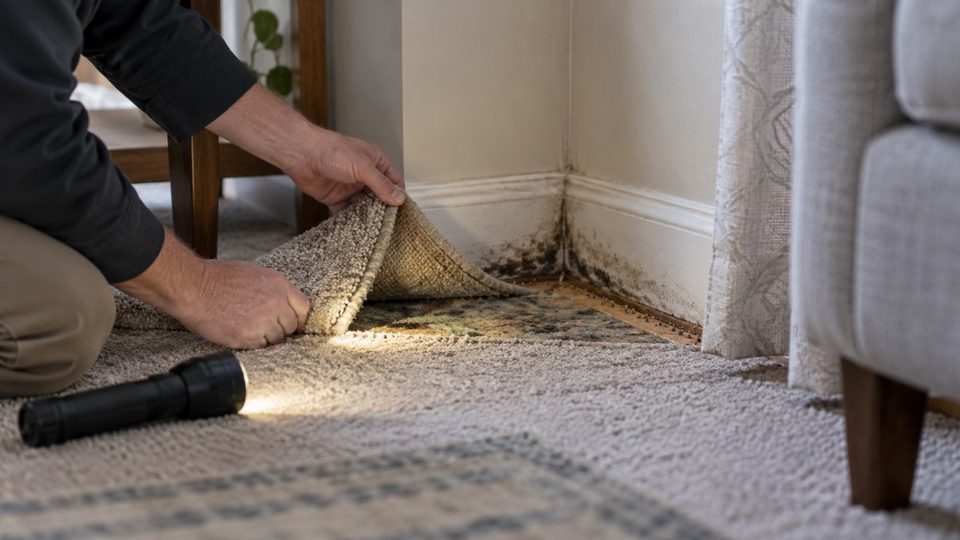
The Three That Mean Stop Looking and Make a Call
- Visible growth over about ten square feetAbove that area the EPA's own guidance moves beyond homeowner cleanup, and an area that large means a substantial quantity of water you have not yet accounted for.
- Growth inside the HVAC systemOn the coil, in the plenum, or on supply register vanes. The one machine in the house capable of distributing a local problem to every room.
- Sewage or river water has been in the buildingCategory 3. Porous material comes out regardless of how dry it now feels, and the work is done under containment.
Have a specific situation?
This article covers the general case. For your own building, call and describe what you are seeing. The conversation is free.
(608) 724-1919Free phone consultation.
The Eleven Others, and What Each One Tells You
1. A musty smell with nothing visible
The commonest presentation in a finished basement, and a genuine finding rather than imagination. Growth on the concealed face of drywall produces no visible sign on the room side for a long time; odor is the only thing that escapes. Note that residents habituate and visitors do not, so if somebody comments on a smell you no longer notice, take it seriously.
2. Symptoms that improve when you leave the house
Congestion, cough or irritation that clears on holiday and returns within a day of getting home. Not diagnostic on its own, but a pattern worth recording, because it points at the building rather than the season.
3. Damp that follows a season
July means condensation. March means groundwater. A ceiling stain appearing in summer usually means last February's ice dam. Constant and localized means plumbing. Writing down when narrows the cause faster than anything else you can observe.
4. White crystalline deposit on masonry
Efflorescence, not mold — mineral salt left behind as water evaporates out of the wall. Harmless in itself, and useful evidence: it confirms liquid water is moving through the masonry, and the height it reaches tells you how far.
5. Peeling, blistering or bubbling paint
On a basement wall it usually means moisture pushing out from behind. On a window sill it means water standing on the surface. On an exterior wall in a band it can mean moisture escaping from inside the assembly.
6. A floor that gives slightly, or trim that has swollen
Particleboard, MDF and the bottom of door casings swell irreversibly when wet. A soft spot near a toilet, a dishwasher or an exterior door is a slow leak that has been running for some time.
7. Dark staining on attic sheathing
Read the pattern. Even gray haze on the north plane means general air leakage and ventilation. A defined dark cone means a duct discharging there. Staining at the eaves means blocked intake or ice damming. Black on the nail points only is early-stage condensation.
8. Condensation on the inside of windows
The glass is a gauge. Persistent condensation on a cold morning means indoor humidity is too high for the outdoor temperature — and the same moisture is condensing inside the walls where nobody is looking.
9. A rust line or tide mark in the basement
On shelving legs, on the water heater base, or as a faint horizontal line on masonry. It records a past water event and its height, which is extremely useful if nobody can remember what happened.
10. Insulation that is discolored, compressed or falling
Fiberglass that has been wet slumps and darkens. In a rim joist bay or an attic it marks exactly where the moisture has been.
11. Growth appearing in a straight line or a grid
Following framing members or the pattern of the studs. That is thermal bridging — the framing is colder than the insulated cavity between it, so it condenses first. It points at insulation and air sealing rather than at a leak.
Efflorescence — mineral, not biological. Soot or dust ghosting on cold spots along framing — wipes clean. Old dry water staining with a hard tide line — a record of a past event. Pink film on shower sealant — usually Aureobasidium or a bacterium; a cleaning matter. A single small patch of bathroom mildew — ventilation and a cloth.
What to Do With Your List
Write down what you have seen, where, and when it started — including whether it tracks a season, rainfall, or a specific event. That list is worth more on a phone call than any photograph, because the pattern is what identifies the mechanism. A specialist can usually narrow it a long way before anyone visits, and a fair proportion of these conversations end with a recommendation to buy a dehumidifier and nothing else.
Questions This Article Raises Most Often
Three practical tests. Texture: mold has depth and a fuzzy or speckled quality, while soot and dust are flat films. Wiping: dust and soot come away cleanly and do not return in the same pattern, whereas mold leaves a stain and returns. Location: mold grows where it is damp, so if the patch is somewhere that has no plausible moisture source, look at heating, candles or cooking instead. A pattern following framing lines is usually thermal ghosting rather than growth.
It is enough to investigate, yes. Odor is produced by active microbial growth, so a persistent musty smell means something is growing somewhere — it just does not tell you where. In a finished basement it is frequently the only symptom for years. Start with a hygrometer for two weeks, check behind and under stored items, and run a moisture meter along the lower part of any finished wall. If it persists after that, it is worth a survey.
It is a signal worth recording rather than a diagnosis. The pattern to note is whether symptoms improve when you are away for several days and return within a day of getting home — that points at the building. But dust mites, pets and heating season dryness produce similar patterns, so it is not specific. If it coincides with any of the physical signs on this page, the two together are worth acting on.
The settle-plate kits sold in hardware stores tell you almost nothing useful. They will grow something in nearly any building, including a healthy one, because spores are present in essentially all indoor and outdoor air. They cannot tell you concentration, cannot compare against outdoor conditions, and cannot tell you where the water is. If you need a number you can rely on, you need a pump, a calibrated sampler and an accredited lab. If you do not need a number, the kit answers a question you did not have.