A Seasonal Checklist, Not a Generic List
Buildings in southern Wisconsin fail on a calendar. The vapor drive reverses twice a year, the ground freezes and thaws, and the river rises in spring. A prevention list organized by season is more useful than one organized by room.
Have a specific situation?
This article covers the general case. For your own building, call and describe what you are seeing. The conversation is free.
(608) 724-1919Free phone consultation.
Autumn — Before the First Hard Freeze
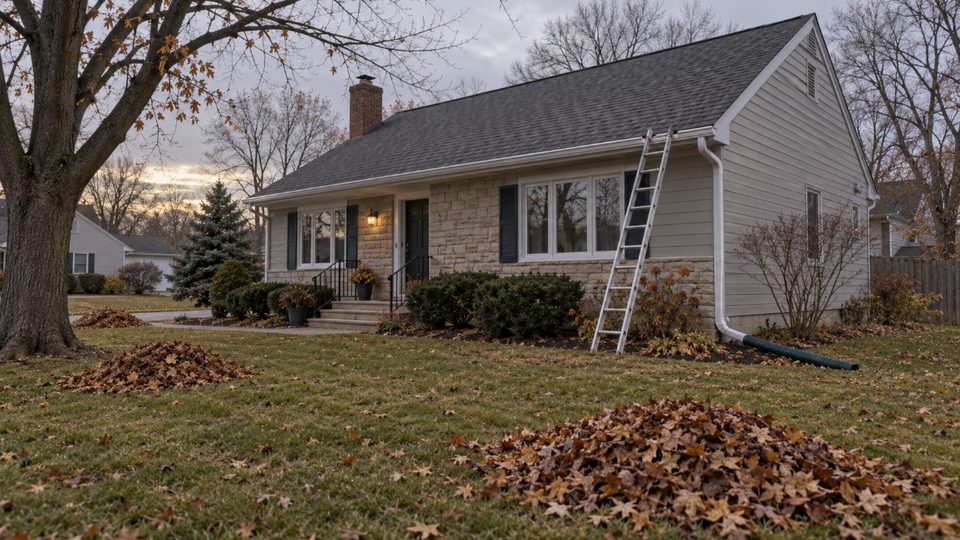
1. Clear the gutters and check the downspouts
Blocked gutters overflow at the eave and put water straight down the wall. Extensions should carry discharge six to ten feet clear of the foundation onto ground that falls away. This is the cheapest single intervention available and it prevents more basement water than anything else on the list.
2. Check the grading
Soil settles over decades and the eye adapts to it. Use a level rather than judgment. You want fall away from the wall for the first six feet. Pay particular attention to any patio, stoop or slab that has heaved — a slab now sloping toward the house delivers water to the foundation every time it rains.
3. Disconnect and drain outside taps
And close the interior isolating valve if there is one. A split outside tap line discharges inside the wall, and it is one of the commonest first freezes of the season.
4. Test the sump pump and the backup
Pour a bucket into the pit. It should start promptly, run smoothly, empty the pit and shut off cleanly. Then check outside that water is actually leaving the discharge well clear of the building. If there is no battery backup, fall is the time to add one — the failure comes in a spring storm that also takes the power out.
Winter — While the Mechanisms Are Active
5. Turn the humidifier down as the temperature drops
30 to 35 percent at 0 to 20°F outside, 25 to 30 percent in a deep cold snap. Persistent condensation on the inside of the windows means it is set too high, and the same moisture is condensing inside your walls.
6. Go into the attic during a cold spell
Ten minutes with a flashlight, while the mechanism is running. Frost on the underside of the sheathing, damp nail points, or discolored insulation all tell you what is happening now — and none of it will be visible in June, which is when most people look.
7. Check downspouts during a thaw
Specifically for ice at the bottom bend causing discharge at the joint, against the wall, at the worst possible time. Also rake snow off the lower few feet of roof before a thaw if the house has a history of ice dams — from the ground, never from a ladder.
8. Keep the heat on, and never below 55°F
Including when away. Open cabinet doors under sinks on exterior walls during extreme cold, and let a tap drip on vulnerable runs. The saving from a lower setting is small; the exposure is a split line in a wall.
Spring — When the Ground Is Still Frozen
9. Watch the basement through the thaw
This is the season that tells you the truth about a foundation. Frozen ground cannot absorb meltwater, so it arrives at the wall; and on low ground the water table follows the Rock River. Anyone thinking of finishing a basement should watch it through one full spring first.
Summer — The Opposite Problem
10. Dehumidify the basement and keep it closed
From April to October, a dehumidifier plumbed to a drain, set to 45 to 50 percent. And keep the basement windows shut, because outdoor air in July is warmer and wetter than the basement and condenses on the masonry. Airing out a basement in summer makes it damper.
Look at the rim joist at the coldest corner. Look under both sink cabinets with a flashlight. Look behind the water heater and the washing machine. Read the hygrometer. That is four things, it takes two minutes, and it catches the majority of what turns into an expensive problem in this housing.
What Not to Bother With
- Annual duct cleaning. Not supported as a preventive measure. Change the filter and have the coil inspected instead.
- Mold-resistant paint as a strategy. Useful in a bathroom; not a substitute for ventilation or for fixing a leak.
- Air purifiers as prevention. They filter; they do not dry.
- Waterproof coatings on older masonry. Traps water in the wall, and on limestone it spalls the stone through the freeze-thaw cycle.
- Opening the basement in summer. The single most counterproductive habit in this climate.
Questions This Article Raises Most Often
Two moments, and they show you different things. A cold spell in midwinter, in the attic, while condensation is actively forming — frost and damp nail points are visible then and invisible in summer. And during the spring thaw, in the basement and outside at the downspouts, because that is when frozen ground and meltwater combine. Checking in July tells you least, which is unfortunately when most people look.
The seasonal items once each, at the season they belong to — perhaps two hours across the whole year. The two-minute quarterly check is the one worth building into a routine, because it catches slow leaks behind appliances and under sinks, which are the cheapest problems to fix early and among the most expensive to find late.
Then measure rather than add more interventions. Put a hygrometer down there for two weeks and note whether the damp tracks humid weather or rainfall. Tape a square of clear plastic to the wall for two days: moisture on the room side means condensation, moisture on the wall side means water coming through the masonry. That test costs nothing and separates the two mechanisms, which is what decides what to do next.
The principles hold; two items change. On a pre-1900 house with a limestone cellar, do not apply any sealing coating to the walls — manage the humidity mechanically instead, because those walls need to dry inward. And if the framing is balloon rather than platform, air sealing at the top and bottom of the wall cavities matters much more than in a modern house, because otherwise cellar air travels straight up into the roof space.