When You Genuinely Do Not Need One
Starting here, because it is the part most articles on this subject skip.
The EPA's own guidance is that a homeowner can generally handle mold covering less than about ten square feet, on hard non-porous surfaces. Detergent and water, gloves, an N95, thorough drying, and correction of whatever made the surface wet. That genuinely covers a large proportion of household situations: bathroom grout, a window reveal, a patch behind a wardrobe on an outside wall.
Two more situations where the answer is not a remediation contractor:
- Seasonal basement condensation. Damp in July, dry in January. The answer is a dehumidifier plumbed to a drain and some air sealing — a few hundred dollars of equipment rather than a few thousand of labor.
- A bath fan discharging into the attic. A ventilation correction, not a remediation. Fix the duct and the mechanism stops.
Have a specific situation?
This article covers the general case. For your own building, call and describe what you are seeing. The conversation is free.
(608) 724-1919Free phone consultation.
When You Do
- More than roughly ten square feet of growth
- Anything inside a wall cavity, under a floor, or in a ceiling void
- Growth in the HVAC system — coil, plenum or ductwork
- Sewage or river water has been in the building
- Material has been wet for more than about two days
- Growth that returns after cleaning
- Anyone in the household is immunocompromised, or asthmatic and symptomatic
- You need documentation for an insurer, a landlord, a buyer or a court
The Wisconsin Position on Licensing
Wisconsin issues no state license for mold inspection or mold remediation. No board, no exam, no register, no complaint process specific to the trade. Anyone may describe themselves as a mold remediation specialist and legally do the work.
This is the same position as most states and it is not cause for alarm — plenty of excellent contractors operate here. What it means is that the verification is yours to do, and that there is no shortcut.
Construction work on one- and two-family dwellings requires a Wisconsin Dwelling Contractor credential through DSPS, and it is checkable free through the DSPS credential lookup. So for the rebuild half of any project there is something concrete and verifiable to ask for — which is more than homeowners in some states get. Ask for it, and check it.
The Four Documents to Ask For
- General liability and pollution liability insuranceAsk for the certificate, and note that general liability alone frequently excludes mold — pollution liability is the one that matters here. Verify it is current.
- IICRC certification for the person doing the workS520 for mold remediation, S500 for water damage. Certification attaches to individuals, not firms, so ask who will actually be on site.
- A written scope of work, before anything startsSpecifying containment, what is removed, the drying target, and who performs clearance. This is the document that makes quotes comparable.
- Wisconsin DSPS Dwelling Contractor credentialFor any construction or repair element. Checkable online in a minute.
A contractor who objects to being asked for those four has told you something useful, and it cost you nothing to find out.
Independent Clearance Is the Real Safeguard
In an unlicensed trade, the single most effective protection available to you is a clearance test performed by somebody with no financial interest in the result. Agree in the contract, before work begins, who performs it and who pays for a retest if it fails. Better still, make final payment contingent on a passing independent clearance — that one clause aligns everybody's interests correctly and costs nothing to insert.
Comparing Quotes That Look Different
The usual reason two quotes differ by a factor of three is that they are for different jobs. Put them on the same scope and the numbers become comparable:
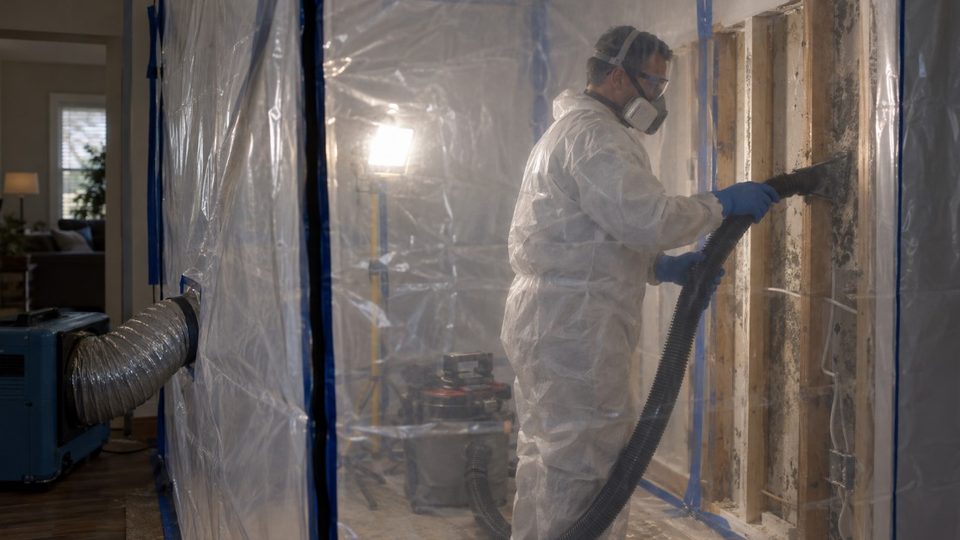
- Does each include containment and negative air with HEPA filtration?
- Does each remove porous material, and to what boundary?
- Does each dry to a documented moisture target, with daily logs?
- Does each include independent clearance, and by whom?
- Does each address the moisture source, and is that priced or excluded?
- Is reconstruction included or separate?
Write that list down and hand the same sheet to each contractor. It takes ten minutes and it is the single most effective thing a homeowner can do to avoid buying the cheapest incomplete job.
Warning Signs
- A firm price quoted over the phone before anyone has seen the property
- Pressure to sign the same day
- “We will test and if it is positive we will remediate” from the same company, with no independent clearance
- Fogging or coating proposed as the whole job, with no removal of wet material
- Reluctance to provide insurance certificates or certification details
- No mention of why the material was wet
- An offer to waive your insurance deductible — which is insurance fraud, and tells you how they operate
Questions This Article Raises Most Often
The DSPS credential lookup covers Dwelling Contractor credentials and is free to search online. For IICRC certification, the IICRC maintains a verification facility and certification attaches to named individuals rather than to companies — so ask for the name of the technician who will be on site, not just the firm. Insurance certificates should come directly from the insurer or broker rather than as a photocopy, and you can call to confirm they are current.
Not inherently, and size is a poor proxy for either. What actually predicts quality is the same in both cases: current insurance including pollution liability, IICRC certification for the person doing the work, a written scope, and willingness to accept independent clearance. Some national franchises are excellent and some local outfits are excellent; the documents distinguish them far better than the letterhead does.
This is what the clearance test and the contract terms are for, which is why both should be settled before work starts. A failed clearance identified while containment is still up is straightforward to correct. A problem discovered after the walls are closed is a dispute. Agree in writing: who performs clearance, who pays for a retest, what the warranty covers and for how long, and what voids it. Ten minutes at the contract stage.
Sensibly, yes, and it can save a real amount. The parts most suited to a homeowner are the preparation and the aftermath: clearing the space, removing contents, correcting the exterior water — gutters, downspout extensions, grading — and the rebuild if you have the skills. What is worth leaving to somebody equipped for it is the containment, the removal of contaminated material, and the structural drying, because those are where doing it badly makes things worse rather than merely slower.
No. It is insurance fraud, and it is usually funded by inflating the claim somewhere else. Beyond the legal exposure to you, it tells you how the firm approaches documentation generally — and documentation is precisely what you are relying on in an unlicensed trade. Decline, and take it as a reason to get another quote.