The Order Almost Everybody Gets Wrong
An air purifier bought before the moisture is fixed is money spent on the symptom. It will run continuously, remove some particles from the air in one room, and change nothing about the wet material producing them.
The hierarchy that actually works, in this order:
- Control the moisture sourceEverything else is downstream. A house with a wet basement has an air quality problem no filter can solve.
- Ventilate, and verify it goes outsideBath and kitchen exhaust terminating through the roof or a wall. The most commonly wrong item in Rock County housing.
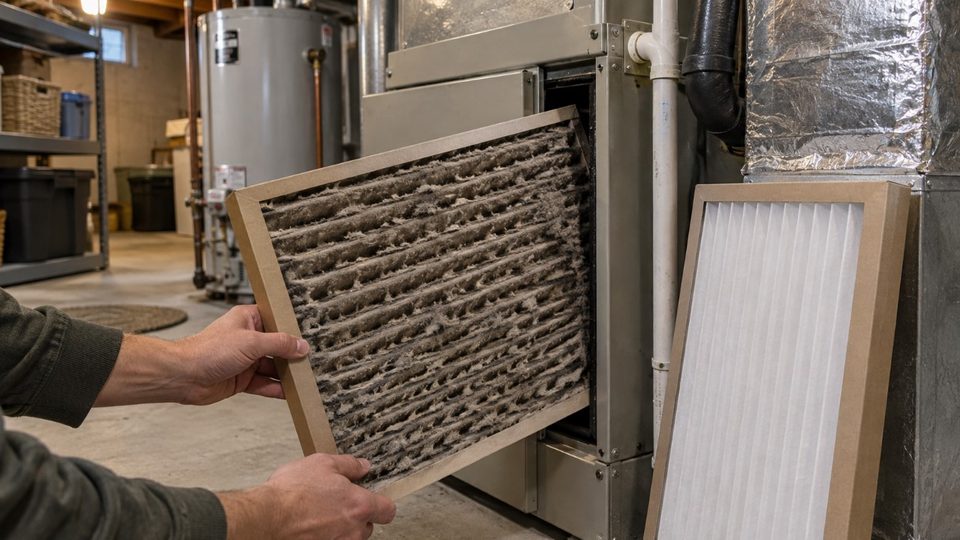
- FilterMERV 11 to 13 in the air handler, changed on schedule. Check the furnace can take the pressure drop.
- Then, if you still want one, a portable unitTrue HEPA, sized to the room. Useful for a bedroom; irrelevant to the building.
Have a specific situation?
This article covers the general case. For your own building, call and describe what you are seeing. The conversation is free.
(608) 724-1919Free phone consultation.
Humidity Through a Wisconsin Year
This is where cold-climate numbers differ from generic advice, and where furnace humidifiers quietly do damage.
| Season | Target indoor RH | Why |
|---|---|---|
| Deep winter, below 0°F outside | 25–30%% | Above this it condenses inside walls and on windows. |
| Winter, 0–20°F | 30–35%% | The comfort floor. Windows tell you when you have gone too far. |
| Shoulder seasons | 35–45%% | Humidifier off. This is when people forget. |
| Summer | 45–50%% | Dehumidify, particularly the basement. Do not open basement windows. |
| Basement, April–October | 45–50%% | A dehumidifier plumbed to a drain is the best purchase in this county. |
Why the Basement Sets the Whole House
Stack effect. In a cold climate, warm air rises and escapes at the top of the building, drawing replacement air in at the bottom. In practical terms a Janesville house in January is continuously pulling air out of the basement and distributing it upstairs.
So a damp basement is not a basement problem — it is a whole-house air quality problem, and it explains the common complaint that upstairs bedrooms smell musty while the basement seems unremarkable. Fix the basement and the bedrooms improve, without anything being done to the bedrooms.
The Air Handler Is the Other Half
A furnace and evaporator coil sitting in a humid basement draws that air across a permanently wet, dark, dust-fed surface and delivers it to every room. This is the single most effective distribution mechanism in a house.
The practical consequence: the coil and the condensate pan matter considerably more than the ducts. A cleaning that does the ductwork and leaves the coil has cleaned the pipe and left the source. The EPA's own position is that routine duct cleaning has not been shown to prevent health problems, and is warranted when there is visible growth, vermin or actual debris blocking ducts — not as an annual ritual.
Newer Houses Have the Opposite Problem
Recent construction around Janesville is built to modern energy codes, which means very low air leakage. Excellent for heating bills, and it means the water vapor a household generates has no route out unless one is provided mechanically. Without a working HRV or ERV, humidity climbs through the winter and appears on the coldest interior surfaces — north-facing corners, behind furniture on outside walls, inside closets.
A humidity complaint in a five-year-old house here is almost always a ventilation deficit rather than a defect. Check three things: whether the house has an HRV or ERV and whether it is switched on, whether bath fans run long enough (twenty minutes, which realistically means a timer), and what a hygrometer actually reads.
The Cheapest Improvements, Ranked
- A hygrometer, so you are measuring rather than guessing — about $15
- A timer switch on the bathroom fan — about $30
- Turning the furnace humidifier down, and off by March — free
- Rerouting a bath fan duct to terminate outside — a few hundred dollars
- A basement dehumidifier plumbed to a drain — a few hundred dollars
- MERV 11–13 filter, changed on schedule — tens of dollars a year
- Coil and condensate pan cleaned at the next service — part of maintenance
All of that together costs less than one portable air purifier of the kind usually bought first, and every item addresses a cause rather than a symptom.
Questions This Article Raises Most Often
No, and it is worth being blunt about it. A purifier removes some airborne particles from one room while it runs. It does nothing about the wet material producing them, and the moment it is switched off the situation is exactly as before. Purifiers are a reasonable comfort measure during remediation or for somebody with allergies. Buying one instead of fixing the moisture is the most common money-wasting decision in this field.
Lower than most people expect, and it should move with the outdoor temperature: around 30 to 35 percent when it is 0 to 20°F outside, dropping to 25 to 30 percent in a deep cold snap. Your windows are the gauge. Persistent condensation on the inside of the glass on a cold morning means the humidity is too high for that temperature, and the same moisture is condensing inside the walls where you cannot see it.
It is if there is something in the ducts and it is not if there is not. The parts that reliably matter are the evaporator coil and the condensate pan — permanently wet, dark and in the airstream. Ductwork itself is usually dusty rather than contaminated. Ask to be shown photographs of the inside of your own system before agreeing to anything; a reputable contractor will have them, and they settle the question in a minute.
In a tightly built recent house, generally yes, and in many it was fitted at construction and has been switched off by an owner who did not know what it was. In an older leaky house it is less critical because the building ventilates itself, inefficiently. The test is a hygrometer: if indoor humidity sits above 50 percent through the winter and the windows run with condensation, the house is not exchanging enough air and something mechanical has to do it.
Not in summer, and this is the most common piece of well-meant bad advice locally. Outdoor air in July is warmer and considerably wetter than the basement, so opening the windows delivers moisture to masonry that is sitting in the low 50s, where it condenses. You are supplying the problem rather than removing it. Keep the basement closed and dehumidify it. In winter the physics reverses, but by then the basement is not the humid part of the house.