Five Things That Change the Outcome Here
Not a generic list. These are chosen because they address the specific ways buildings in southern Wisconsin get wet, and because each one is either free or costs a few hundred dollars.
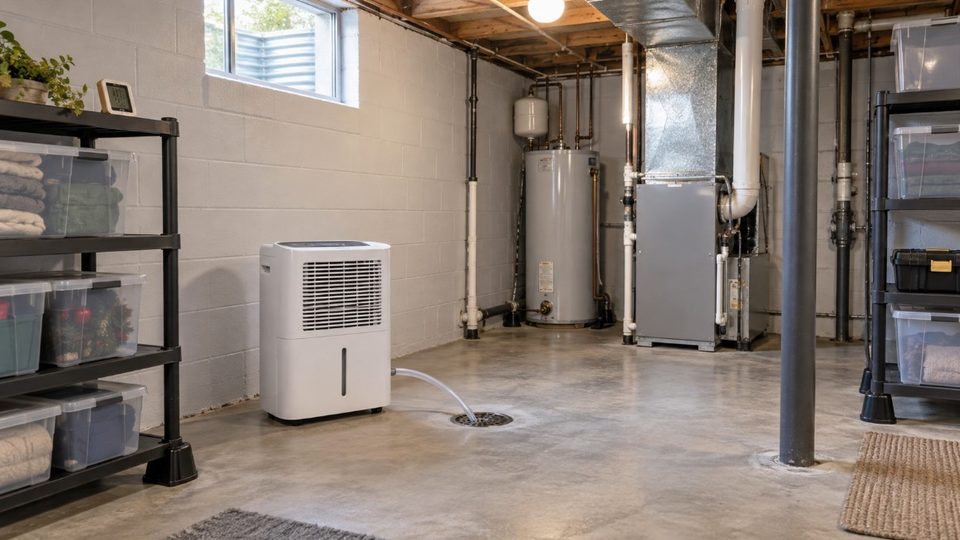
1. A dehumidifier in the basement, plumbed to a drain, April to October
The single highest-value purchase available to a homeowner in this county. It addresses summer condensation on cold masonry, which is the largest cause of basement mold here and the one most frequently misdiagnosed as a leak.
Two details matter. Plumb it to the sump or a floor drain — a unit that stops when a bucket fills is not controlling anything, and the buckets do not get emptied in September. And set it to 45 to 50 percent and leave it, rather than switching it on when the basement feels damp, because by the time it feels damp the humidity has been high for weeks.
2. Downspout extensions, checked during a thaw
Costs very little and removes more water from a foundation than almost anything else. Discharge six to ten feet clear of the wall, onto ground that falls away.
The Wisconsin-specific part is the thaw check. A downspout that ices up at the bottom bend discharges at the joint instead — directly against the foundation — for weeks, at exactly the time when frozen ground cannot absorb anything. Go out during a February thaw and look at where the water is actually coming out. Most people check gutters in October and never look again.
3. Trace every exhaust duct to where it actually ends
Fifteen minutes with a flashlight in the attic. Bathroom fans, the laundry, the range hood if it is ducted. You are looking for a duct that ends in the attic, ends in a soffit, or does not exist at all.
A bath fan discharging into a Wisconsin attic puts every shower onto cold sheathing where it condenses and, in a deep freeze, frosts. A disconnected dryer vent is worse, because a dryer moves several liters of water per load. Both are a few hundred dollars to correct and both stop the mechanism immediately.
4. Turn the furnace humidifier down, and off by March
Free, and it prevents a surprising amount. Whole-house humidifiers are common in this housing and are frequently left at a winter setting well into spring. The moisture they add condenses on windows, in north-facing corners, and inside wall cavities where nobody sees it.
Target 30 to 35 percent when it is 0 to 20°F outside, 25 to 30 percent in a deep cold snap, and off once the weather turns. Use the windows as the gauge: persistent condensation on the glass on a cold morning means the setting is too high.
5. Air seal and insulate the rim joist
The band of framing sitting on top of the foundation is the coldest wood in a Wisconsin building and it is almost always packed with a bare fiberglass batt that stops neither air nor vapor. Warm indoor air reaches cold framing and condenses on it, all winter, where nobody looks.
Check it first: pull back a section of batt at the coldest corner and look at the wood with a flashlight. Correcting it runs $800 to $2,500 for a typical house and improves comfort upstairs as a side effect, so the payback is better than the headline suggests.
Hygrometer $15 · humidifier turned down, free · downspout extensions, tens of dollars · bath fan timer $30 · dehumidifier plumbed to a drain, a few hundred · duct rerouting, a few hundred · rim joist $800–$2,500. Everything except the rim joist comes in under a thousand dollars in total, against a finished basement remediation at $4,000 to $12,000.
Prices shown are examples only. For an accurate quote for your specific situation, call (608) 724-1919 — free consultation with a specialist.
Have a specific situation?
This article covers the general case. For your own building, call and describe what you are seeing. The conversation is free.
(608) 724-1919Free phone consultation.
Popular Advice That Does Not Help Here
- Opening basement windows in summer to air it out. Imports moisture onto cold masonry. Actively counterproductive.
- Bleaching visible mold on porous material. Removes the stain, leaves what is below the surface, and the water in the bleach feeds it.
- Buying an air purifier before fixing the moisture. Treats the symptom, indefinitely.
- Adding attic insulation without air sealing first. Keeps the deck colder while the same moisture arrives, and frequently buries the soffit intakes.
- Waterproof paint on a basement wall. Does nothing for condensation, and on older masonry it traps water in the wall.
Questions This Article Raises Most Often
Put a hygrometer in the basement, because measuring is what makes the other decisions obvious. If it reads above 60 percent through the summer, buy the dehumidifier and plumb it to a drain — that is the highest-value purchase available in this county. If it reads fine, your problem is somewhere else and you have saved yourself the money and the diagnosis time.
Excluding the rim joist work, the whole list comes in comfortably under a thousand dollars: hygrometer, downspout extensions, a bath fan timer, turning the humidifier down, and a dehumidifier plumbed to a drain. Rerouting a bath fan duct adds a few hundred. The rim joist runs $800 to $2,500. Against a finished basement remediation at $4,000 to $12,000 before reconstruction, the arithmetic is not close.
Yes, continuously from around April to October, on a humidistat so it cycles rather than running flat out. Switching it on when the basement feels damp is too late, because by then the humidity has been high for weeks and material has already been absorbing it. Plumbed to a drain and set to 45 to 50 percent, it manages itself and you can forget about it, which is the point.
The hygrometer, the dehumidifier and how you use the ventilation are all yours. Downspouts, duct rerouting and rim joist work are the landlord's. What is worth doing is putting the building items in writing as a repair request, with the hygrometer readings attached — measurement makes a request concrete and much harder to dismiss than a complaint about damp. See mold in a Wisconsin rental.